Employee Compensation and Benefits During Closures and Furloughs
As business closures increase due to the COVID-19 pandemic, employers are faced with questions about compensation and health benefit coverage for their employees. Government relief measures may provide compensation for businesses and individuals in certain situations. In other cases, existing rules on employee rights will apply.
Paid leave may be required for some employees by federal
or state law. Also, some state insurance regulators are requiring insurance
carriers to provide policyholders with additional flexibility regarding
premiums and coverage, and some carriers are making similar changes independent
of state requirements.
This Compliance Overview provides a summary of the issues that employers may encounter when terminating or suspending employment due to COVID-19.
Employee Compensation
Employees are generally not required to be paid
for time spent not working.
Exceptions apply to exempt employees who work
for part of a workweek and employees eligible for paid leave.
Employers
may provide paid leave beyond what is required.
Employees may be eligible for expanded unemployment
benefits.
Employee Benefits
Whether employees remain eligible for benefits while not working depends on the terms of the plan.
Benefit eligibility may also depend on the reason the employee is not working.
State or carrier guidelines may provide additional flexibility for group health plans.
Furloughs
A furlough is a way for employers to deal with a reduction of
work. During a furlough, employees remain on the employer’s payroll but their
hours of work are reduced. Typically, employers establish furloughs by asking
employees to work fewer hours or by asking them to take unpaid time off.
Employers should be careful when furloughing employees who
are exempt from the Fair Labor Standards Act (FLSA). The FLSA requires that
exempt employees receive their weekly salary regardless of the number of hours
they work during the week. However, the FLSA does not require employers to
compensate exempt employees for any week in which they do not perform any work,
so employers may elect to furlough exempt employees by reducing their work a
week at a time.
Whether employee benefits are provided during furloughs will
depend on the terms of each plan. In many cases, employees must work a specific
number of hours to remain eligible for benefits. However, in some cases,
furloughs may be treated differently than other types of hours reductions.
During the COVID-19 pandemic, some insurance carriers and state regulators are
providing additional flexibility to help employers maintain coverage for
employees on furlough.
Layoffs
Layoffs can be structured in several different ways. A layoff
is typically a temporary separation from payroll. Most often layoffs take place
when there is not enough work for employees to perform. Employers use layoffs,
rather than terminations, because they believe the conditions leading to the
reduction in work will change. Employers that use layoffs generally intend to
recall employees who are laid off once enough work becomes available. However,
layoffs can also be permanent.
As with furloughs, whether a laid-off employee remains
eligible for any employee benefits will depend on the terms of each plan. If
employment is terminated, eligibility will generally also be terminated,
subject to any continuation coverage requirements. Employees may be able to collect
unemployment benefits if they meet their state’s eligibility requirements.
Continued Health Care Coverage
Employers may continue active group health care coverage for
laid-off employees or furloughed employees if this is allowed by the terms of
their health plan. For example, a health plan may indicate a minimum number of
hours employees must work to be eligible for coverage and instructions for how
to account for short-term leaves of absence, whether paid or unpaid.
Employers may have the option of amending their plan’s terms
and conditions if they do not allow for a continuation of benefit coverage.
However, if applicable, employers should check with their third-party insurer
or administrator before amending the terms and conditions of their health
plans. Employers that expand coverage outside the terms and conditions of the
plan without consent from the insurer (or stop loss carrier) face significant
financial exposure.
In addition, during a layoff or furlough, employers may choose
to pay the employee share of premiums, in full or in part. Employers that pay
for employee premiums will need to comply with any applicable cafeteria plan
rules and nondiscrimination requirements to ensure favorable tax treatment.
COBRA and State Continuation Coverage During a layoff, and depending on the terms of the health plan, employees may have the right to maintain their health insurance coverage through the federal Consolidated Omnibus Budget Reconciliation Act (COBRA). Both termination of employment and a reduction in hours of service that causes a loss of eligibility for coverage are considered COBRA- qualifying events, that would entitle an employee (and any covered dependents) to elect up to 18 months of COBRA continuation coverage.
COBRA applies to employers with 20 or more employees, but
many states have adopted similar versions of this law for employers with fewer
employees. These state laws generally apply to insured group health plans.
Group health plans can require qualified beneficiaries to
pay for COBRA continuation coverage, although plan sponsors can choose to
provide continuation coverage at reduced or no cost. The maximum amount charged
to qualified beneficiaries cannot exceed 102% of the cost to the plan for
similarly situated individuals covered under the plan who have not incurred a
qualifying event.
Affordable Care Act (ACA) Employer Shared Responsibility Penalties
Terminating group health coverage for a full-time employee
during a layoff or furlough may trigger an employer shared responsibility penalty
for applicable large employers (ALEs) if the employee is still considered to be
employed by the employer. This is more likely to be an issue for ALEs that use
the look-back measurement method. Individuals who are determined to be
full-time employees for a stability period must be offered coverage for the
entire stability period as long as they remain employed.
In addition, ALEs that elect to maintain coverage during a
furlough or layoff must ensure that the coverage remains affordable, as defined
by the ACA, to avoid penalties. Depending on the circumstances, this may
require a continued or increased employer subsidy, whether on active or COBRA
coverage.
Wages under the FLSA
In general, the FLSA applies only to hours actually worked.
This means that employers are not required to compensate their employees for
any hours they are not working, including layoffs and furloughs. However, as
mentioned above, exempt salaried employees must be paid their full weekly
salary, regardless of the number of hours they work each week.
In an effort to promote social distancing, federal and state
governments have been encouraging individuals to work remotely as much as
possible. An employer’s responsibility to comply with FLSA and state wage and
hour requirements does not change merely because an employee is working
offsite.
However, employers should consider the following issues when
instituting remote work practices:
It may become easier for employees to work additional hours if they are working remotely. Employers will need to establish accurate time-keeping practices to ensure compliance with overtime wage payment requirements.
Employees working on critical infrastructure may see an increased number of on-call hours of work. Employers should consider how theses situations impact their compensation structure.
Employers should also ensure that employee break and meal times are respected as required by law. Accounting for meal and break periods is another reason to implement accurate time-keeping practices.
The Families First Coronavirus Response Act (Families First Act) As part of sweeping legislation signed into law by President Trump on March 18, 2020, two laws were enacted that provide workers with paid leave for reasons related to the coronavirus (COVID-19) pandemic. One of the new leave provisions, the “Emergency Family and Medical Leave Expansion Act,” allows 12 weeks of partially compensated FMLA leave to care for a child whose school or child care facility has been closed due to COVID-19. The leave applies only to workers who have been employed by their current employer for 30 days.
The other new law providing employee leave, the “Emergency Paid Sick Leave Act,” requires employers
to provide up to 80 hours of paid sick time to employees in
specified circumstances, including:
A quarantine or isolation order for the employee
or someone the employee is caring for, or medical advice to self-quarantine;
When the employee has symptoms of COVID-19; or
The closure of the employee’s child’s school or
child care facility.
Employers with 500 employees or more are exempt from the laws, and employers may
exclude employees who are health care
providers and emergency responders.
The legislation also allows for future regulations
exempting businesses with fewer than 50
employees from providing leave for child care reasons if the leave would
jeopardize the viability of the business. The new employee leave mandates take
effect on April 1, 2020, and expire on Dec. 31, 2020.
Unemployment Compensation
Employers that continue health coverage for laid-off or
furloughed employees do not automatically jeopardize their employee’s
eligibility for unemployment benefits.
The Families First Act encourages states to waive limitations
on UI benefits (such as waiting weeks and work-search requirements) for
COVID-19-related claims. The Act also provides federal funds to
help states pay for increased UI claims caused by the outbreak. Specifically,
the U.S. Department of Labor has indicated that states may allow for UI benefits
where:
An employer temporarily ceases operations to
prevent employees from coming to work due to COVID-19;
An individual is quarantined with the
expectation of returning to work after the quarantine is over; and
An individual leaves employment due to a risk of
exposure or infection, or to care for a family member affected by COVID-19.
The DOL has also clarified that an employee is not
required to quit in order to receive benefits due to COVID-19.
While each state administers a separate unemployment
insurance program, all states follow the same guidelines established by federal
law. Employees are encouraged to contact their state’s unemployment insurance
program for questions regarding eligibility and benefits during these
unprecedented times.
Mass Layoffs
Mass layoffs take place when plants or businesses shut down
and multiple employees are laid off at the same time. The federal Worker Adjustment and Retraining
Notification (WARN) Act requires employers with 100 or more employees
to provide at least 60 days’ advance written notice of any plant closing or
mass layoff that affects 50 or more employees at a single site of employment.
Given the rapidly changing nature of the COVID-19 pandemic and its effect on businesses, relief from the advance notice requirements may be available. It may not be possible for employers to satisfy the required notice period when businesses must be shut down unexpectedly.
In fact, the WARN Act allows employers to provide fewer
than 60 days’ notice when an “unforeseeable
business circumstance” exists. This exception still requires employers to
give as much advance notice as possible. As with most exceptions, employers
will need to prove that they have met required conditions for it to apply.
A circumstance is unforeseeable when it is caused by some
sudden, dramatic and unexpected action or condition that is outside the employer’s control. An
unanticipated and dramatic major economic downturn or a government-ordered
closing of an employment site that occurs without notice may each be considered
a business circumstance that is not reasonably foreseeable. The test for
determining when business circumstances are not reasonably foreseeable focuses
on an employer’s business judgment. The employer must exercise commercially
reasonable business judgment, and this is measured by whether the same judgment
would be used by a similarly situated employer in predicting the demands of its
particular market. The employer is not required, however, to accurately predict
general economic conditions that may affect demand for its products or
services.
Some states have also adopted similar versions of the federal WARN Act, which usually apply to smaller employers or smaller layoffs. Many of these states have provided a waiver from their advance notification requirement if the layoffs are caused by COVID-19. Employers are urged to check with their local agencies to determine whether they are subject to state WARN requirements, and whether waivers for their situation have been authorized.
California’s Leader in Insurance and Risk Management
As one of the fastest growing agencies in California, GDI Insurance Agency, Inc. is able to provide its clients with the latest and greatest of what the insurance industry has to offer and much, much more.
We are headquartered in Turlock, CA, with locations across the heart of California’s Central Valley, Northern California and beyond to provide a local feel to the solutions and services we provide our clients. We pride ourselves on exceeding our client’s expectations in every interaction to make sure that our client’s know how much we value and appreciate their business. Contact us today 1-209-634-2929 for your comprehensive insurance quote!
The World Health Organization (WHO) has designated the recent coronavirus outbreak (COVID-19) a global public health emergency. According to the Centers for Disease Control and Prevention (CDC), coronaviruses are common in animal species. Although most don’t affect humans, the most recent strain, COVID-19, does and can easily spread from person to person. What you need to know about coronavirus and an event.
Coronaviruses typically cause mild upper
respiratory tract illnesses, and those affected exhibit cold-like symptoms
(e.g., headache, cough, fever, sore throat and runny nose). Some coronaviruses,
like COVID-19, can be more severe, and individuals may experience
lower-respiratory tract illnesses like bronchitis and pneumonia. For the
elderly, infants and those with weakened immune systems, COVID-19 can be
deadly.
Because COVID-19 is highly contagious and
potentially life-threatening, it’s critical that organizations take the proper
precautions to protect individuals. This is especially true for businesses that
plan on hosting large events where just one misstep can lead to the quick
spread of COVID-19 among attendees. This Risk Insights highlights guidance from
the CDC regarding preparing your event for coronavirus.
Review Emergency Operation Plans
The first step
for preparing your event for COVID-19 involves reviewing your emergency
operations plan. To accomplish this, consider doing the following:
Meet with the emergency operations coordinator or planning team at your venue. Discuss the emergency operations plan and determine how it may impact aspects of your event, such as personnel, security, services, activities, functions and resources. Develop a contingency plan that addresses various scenarios.
Establish relationships with key community partners and stakeholders. When forming key relationships for your event, include relevant partners, such as the local public health department, community leaders, faith-based organizations, vendors, suppliers, hospitals, hotels, airlines, transportation companies and law enforcement officials. Collaborate and coordinate with them on broader planning efforts. When doing so, clearly identify each partner’s role, responsibilities and decision-making authority. You should also contact your local public health department for a copy of their outbreak response and mitigation plan for your community and participate in communitywide emergency preparedness activities.
Address Prevention Strategies in Your Emergency Operations Plan
The second step
for preparing your event for COVID-19 involves addressing prevention strategies
in your emergency operations plan. To accomplish this, consider doing the
following:
Promote
preventive actions. Use health messages and materials developed by credible
public health sources—such as your local public health department or the CDC—to
encourage your event staff and participants to practice good personal health
habits. Promote everyday
preventive actions to help prevent the spread of COVID-19, recommending
that individuals:
Stay home when they are sick, except to get
medical care.
Cover their mouth with a tissue when they cough
and sneeze.
Wash their hands often with soap and water for
at least 20 seconds, especially after going to the bathroom; before eating; and
after blowing their nose, coughing or sneezing.
Avoid touching their eyes, nose and mouth with
unwashed hands.
Clean frequently touched surfaces and objects
daily.
Provide
COVID-19 prevention supplies at your event. Plan to have extra
supplies on hand for event staff and participants, including hand-washing
stations equipped with soap, hand sanitizer, tissues and disposable face masks
for individuals who are experiencing COVID-19 symptoms.
Plan for
staff absences. Develop flexible attendance and sick-leave policies.
Event staff needs to stay home when they are sick or if they have to care for a
sick household. As such, it’s important to identify critical job functions and
positions, and plan for alternative coverage by cross-training staff.
Promote
messages that discourage people who are sick from attending events. This
should include messages requesting that people leave events if they begin to
have symptoms of COVID-19, which include fever, cough and shortness of breath.
They should seek medical advice promptly by calling ahead to a doctor’s office
or emergency room.
Identify
a space that can be used to isolate staff or participants who become ill at the
event. Designate a space for staff and participants who may become
sick and cannot leave the event immediately. Work with partners, such as local
hospitals, to create a plan for treating staff and participants who do not live
nearby. Include a plan for separating and caring for vulnerable populations.
Plan ways
to limit in-person contact for staff supporting your event. There are several
ways to do this, including offering staff the option to work remotely if they
can perform their job duties off-site. Reduce the number of staff needed by
staggering shifts for staff who support essential functions and services during
events.
Develop
flexible refund policies for participants. Create refund policies that allow
participants to stay home when they are sick, need to care for sick household
members or are at high risk for complications from COVID-19.
Identify
actions to take if you need to postpone or cancel events. Work closely
with local public health officials to assess local capacities in the area.
During a COVID-19 outbreak, resource limitations among local health care
systems or law enforcement can influence the decision to postpone or cancel
your event. If possible, plan alternative ways for participants to enjoy the
event (e.g., television, radio or digital broadcasts).
Communicate COVID-19 to Guests and Event Staff
The third step
for preparing your event for COVID-19 involves creating a communication plan to
keep guests informed. To accomplish this, consider doing the following:
Update
and distribute timely and accurate emergency communication information. Identify
everyone in your chain of communication (e.g., event staff, participants,
suppliers, vendors and key community partners) and establish systems for
sharing information with them. Maintain up-to-date contact information for
everyone in the chain of communication. You should also identify platforms,
such as phone hotlines, automated text messaging systems or websites, to help
disseminate information.
Identify
and address potential language, cultural and disability barriers associated
with communicating COVID-19 information to event staff and participants. Above
all, information you share should be easily understood by everyone attending
the event.
Stay Informed
Despite the current low level of risk for the average American employee, it is important to understand that the COVID-19 situation evolves and changes every day. Employers should closely monitor the CDC and WHO websites for the latest and most accurate information on COVID-19. Source: Centers for Disease Control and Prevention
California’s Leader in Insurance and Risk Management
As one of the fastest growing agencies in California, GDI Insurance Agency, Inc. is able to provide its clients with the latest and greatest of what the insurance industry has to offer and much, much more.
We are headquartered in Turlock, CA, with locations across the heart of California’s Central Valley, Northern California and beyond to provide a local feel to the solutions and services we provide our clients. We pride ourselves on exceeding our client’s expectations in every interaction to make sure that our client’s know how much we value and appreciate their business. Contact us today 1-209-634-2929 for your comprehensive insurance quote!
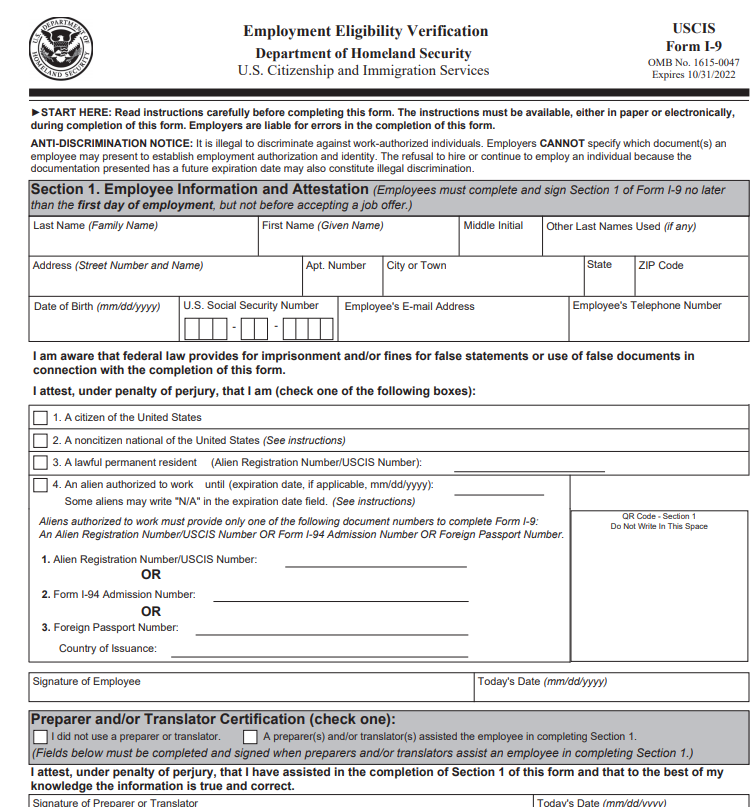
On Jan. 31, 2020, the U.S. Citizenship and Immigration Services (USCIS) published a new version of Form I-9: Employment Eligibility Verification. The previous version of this form expired Aug. 31, 2019, but USCIS advised employers to continue using the expired form until a new I-9 form was made available.
Transition Period For The New I-9 Form
With the new form, USCIS has also clarified that employers
have the option of initially using either the expired or the new Form I-9.
However, employers must begin using the new form exclusively by May 1, 2020.
What’s Different With the New I-9 Form
The paper version of the new form has not changed, but the
electronic form shows a few minor
changes. Specifically, the new form:
Lists additional countries (Eswatini and Macedonia) in the country of issuance field;
Clarifies who can act as an authorized employer representative;
Updates the USCIS website address;
Clarifies the list of acceptable documents;
Updates the process for requesting paper versions of the form; and
Updates the privacy notice from the Department of Homeland Security.
New Expiration Date
The new Form I-9 was approved by the Office of Management and Budget on Oct. 21, 2019 and has a new expiration date of Oct. 31, 2022.
Compliance Review of the New I-9 Form
All U.S. employers must properly complete Form
I-9 for each individual they hire for employment in the United States. This
includes citizens and noncitizens.
Both employees and employers (or authorized
representatives of the employer) must complete the form.
The list of acceptable documents can be found on
the last page of the form.
Employers must retain Form I-9 for a designated
period and make it available for inspection by authorized government officers.
Only
employers and employees in Puerto Rico can complete the Spanish version of Form
I-9.
California’s Leader in Insurance and Risk Management
As one of the fastest growing agencies in California, GDI Insurance Agency, Inc. is able to provide its clients with the latest and greatest of what the insurance industry has to offer and much, much more.
We are headquartered in Turlock, CA, with locations across the heart of California’s Central Valley, Northern California and beyond to provide a local feel to the solutions and services we provide our clients. We pride ourselves on exceeding our client’s expectations in every interaction to make sure that our client’s know how much we value and appreciate their business. Contact us today 1-209-634-2929 for your comprehensive business insurance quote!
Is improving your cyber incident response plan a goal for 2020? In an era of constantly evolving cyber threats and advancing technology, no organization is immune to the risk of a cyber attack. According to recent survey data, 53% of percent of businesses in the United States reported being the victim of a cyber attack in 2019.
That’s
why having a cyber incident response plan is a vital element of any organization’s
approach to business continuity. At a glance, cyber incident response plans
provide business leaders like you with proactive guidance to prevent cyber attacks,
as well as reactive steps to follow if a breach occurs. In other words, having
a cyber incident response plan can help prevent attacks from happening
altogether and limit the damages in the event of a worst-case scenario.
However,
simply having a cyber incident response plan in place won’t guarantee cyber resilience.
Rather, it’s important for your organization to routinely revisit your plan to
make necessary updates and improvements when new threats emerge.
How to Update and Improve Your Cyber Incident Response Plan
Consider the following tips to adequately update and improve your cyber incident response plan in 2020:
Maintain proper
documentation—Make sure your cyber risks are properly documented as a reference point
for improving your incident response plan. Keep in mind that when cyber risks
or threats evolve, your response plan should follow suit. Also, be sure to
document any past cyber incidents that took place. By doing so, you can better
analyze what went wrong and adjust your incident response plan to make sure the
same concern doesn’t happen again.
Prepare for different scenarios—No cyber incident is exactly the same. With this in mind, be sure your cyber incident response plan is multifaceted with tailored steps and preparations based on the type of attack. A common approach is to have varying levels of response based on the severity of the breach. For example, a phishing attack that only infected a single user and led to minimal data loss would call for a different response than a large-scale breach that resulted in significant disruption.Test your plan—In addition to preparing for different forms of cyber attack, it’s also crucial to routinely test your response plan with sample scenarios. Similar to a fire drill, try to involve every employee in the process of testing your response plan. This way, all staff members will know how they play a role, and you will be able to accurately determine the effectiveness of your plan. From there, you can make adjustments as needed and feel more confident in your plan in the event of a real cyber attack.
The LargerBreaches of the Past Decade
Cyber attacks are an increasing threat in terms of both frequency and severity. Businesses of all sizes can be targeted by cyber attacks. Here are five of the most notable data breaches from the past decade:
Target – 2013
Home Depot – 2014
Anthem – 2015
Equifax – 2017
Marriott – 2018
Cyber Security Trends to Watch in 2020
One of the challenges of implementing reliable cyber security and create a cyber incident response plan is that the finish line keeps being moved. As security measures continue to improve, so do the methods and tools of cyber criminals.
There is a range of possible threats to be aware of when it
comes to keeping your organization cyber secure. Here are five potential risks
that industry experts believe businesses should heighten their awareness of in
2020:
Ransomware—Ransomware
attacks can be among the most expensive for your company to have to deal with.
Ransomware refers to a type of malware that can breach and encrypt the victim’s
files. The victim is then forced to make a ransom payment in order to regain
access to their data. In addition, some attackers may also extort your company,
and threaten to disclose or sell your data. Companies are advised to regularly
back up all critical data and keep the backups separate from the rest of your
network.
Phishing—Phishing
emails continue to be one of the most common causes of data breaches. This
threat refers to fraudulent emails that intend to trick employees into
revealing sensitive information. In 2020, phishing kit developers are expected
to make it even easier for potential attackers to launch phishing campaigns. Be
certain that employees are trained in anti-phishing practices and that training
is regularly updated.
Personal
device attacks—According to a 2019 Kaspersky report, approximately
half of all companies reported malware infections on employee-owned devices.
With businesses continuing to increase flexibility for employees to use
personal devices for work-related tasks, attackers may start targeting personal
devices more heavily as a means of bypassing corporate cyber defenses. Adequate
and up-to-date training is necessary for your employees. Companies should
review and update their policies as they pertain to personal devices as well.
Third-party
suppliers—According to a survey by One Identity, 94% of
organizations provide third-party suppliers with access to their network. What’s
more, 18% of organizations reported that a third party was to blame for a data
breach. With digital connections between businesses increasing, the risk of a
data breach occurring because of a mistake by someone outside of your company
is also on the rise. Establish a strict security policy for all third-parties
that access your network, and closely monitor that each user is only given the
permissions they need.
DDoS
attacks—While not as notorious, DDoS attacks are about as
common as ransomware incidents. Network speed increases, such as the wider
release of 5G, also mean that DDoS attacks can be more difficult to stop. Have
your IT department or contractor inspect devices for possible misconfigurations
or vulnerabilities, and be certain that your employees are following your cyber
security policies.
California’s Leader in Insurance and Risk Management
As one of the fastest growing agencies in California, GDI Insurance Agency, Inc. is able to provide its clients with the latest and greatest of what the insurance industry has to offer and much, much more.
We are headquartered in Turlock, CA, with locations across the heart of California’s Central Valley, Northern California and beyond to provide a local feel to the solutions and services we provide our clients. We pride ourselves on exceeding our client’s expectations in every interaction to make sure that our client’s know how much we value and appreciate their business. Contact us today 1-209-634-2929 for your comprehensive cyber liability insurance quote!
What to do When a Co-Worker Has a Medical Emergency
Though no one ever imagines it happening, there is a possibility you might be the closest – or only – employee on the scene when a co-worker has a medical emergency. You do not have to receive extensive first aid training to know how to safely respond. The first step in an emergency is calling for professional help, but what next?
Do
not panic if you are the only one around when a co-worker has a medical
emergency. Remember these response basics to keep the employee as safe as
possible until the paramedics arrive. If you have additional questions or
concerns about this matter, talk to your supervisor or manager.
General
Medical Emergency
Give first aid – but only if you know
how. Try to help the employee, but never attempt to do anything you are not
trained to do or feel uncomfortable doing.
Do not leave the person alone unless you
are in danger or the dispatcher tells you to do so.
Do not move the injured employee unless
he or she is in a life-threatening area. Moving the victim could cause serious
damage, depending on the situation, condition or injury.
Do not move any body parts if you suspect
they are broken.
Seizure
Roll the person onto his or her side and
cushion the head.
Clear the area of sharp or solid objects.
Do not restrict the person from moving
unless he or she is in danger.
Do not put anything in the victim’s
mouth.
Heart
Attack
The most important thing here is
not to panic, and ensure your co-worker stays calm. Panic only constricts the
blood vessels and makes it more difficult on the co-worker’s body.
Excessive
Bleeding
Try to control the bleeding with direct
pressure.
Do not come into contact with the
victim’s blood.
The care you give to the victim before the paramedics arrive can have a huge impact on the overall outcome of the situation and the victim’s chance of survival.
Being Prepared for a Co-worker Medical Emergency
Being prepared for a co-worker medical emergency means that employers need to take the time ensure they have the training and planning in place to effectively respond to an emergency. Any unforeseen crisis that demands an immediate response is an emergency. Emergencies in the workplace can mean a disruption of work; harm to employees or customers; and damage to materials, equipment, or facilities.
The most likely workplace emergency is a medical emergency. A serious medical emergency, such as cardiac arrest, requires immediate attention, and response time is critical. It’s essential that medical first responders know how to perform first aid/CPR.
California’s Leader in Insurance and Risk Management
As one of the fastest growing agencies in California, GDI Insurance Agency, Inc. is able to provide its clients with the latest and greatest of what the insurance industry has to offer and much, much more.
We are headquartered in Turlock, CA, with locations across the heart of California’s Central Valley, Northern California and beyond to provide a local feel to the solutions and services we provide our clients. We pride ourselves on exceeding our client’s expectations in every interaction to make sure that our client’s know how much we value and appreciate their business. Contact us today 1-209-634-2929 for your comprehensive business insurance quote!
According to the United States Fire Administration’s (USFA’s) National Fire Incident Reporting System (NFIRS), approximately 7,410 restaurant building fires occur each year, causing nearly $200 million in property losses. Of these fires, approximately 61% are caused by cooking equipment. Class K Fire Extinguishers can help, find out more below!
Commercial
cooking equipment, like deep fryers, griddles, ranges and woks, can be
particularly dangerous. Not only are they designed to heat food quickly and at
extreme temperatures, but they are also often used with or around flammable
oils, fats and grease.
Should these
combustible materials ignite at your restaurant, they can be difficult to
extinguish. In fact, using the wrong extinguisher on these blazes can cause
fires to spread. Even a Class B fire extinguisher, which is designed to
extinguish flammable liquids, may not be adequate to protect your restaurant,
employees and patrons.
To help businesses address risks related to oil, fat and grease fires, the National Fire Protection Association (NFPA) requires the use of Class K fire extinguishers. Read on to see what these are and considerations related to their use.
Workplace Considerations
Generally, all
fires are classified by the type of fuel that feeds them. These classifications
are used to help individuals determine what extinguishing agents are effective
in combating a particular blaze.
For restaurants,
Class K fires are particularly common and are fueled by flammable liquids unique to cooking practices, such as vegetable- and
animal-based oils, fats and greases. In order to control and put out such
fires, a specialized extinguishing agent is required—a Class K fire extinguisher.
Class K fire
extinguishers are designed to put out oil and fat fires. A Class K fire
extinguisher uses an alkaline mixture that, when sprayed on a blaze, combines
with the fatty acids in oils and fats to create a foam that holds in vapors and
puts out the fire.
The NFPA
requires businesses to keep Class K fire extinguishers no more than 30 feet
away from any cooking appliances that use combustible cooking media (e.g.,
vegetable oil).
Furthermore,
Class K fire extinguishers must be inspected monthly. During these inspections,
you will need to confirm the following:
The extinguisher is
located in a designated area.
The extinguisher is
easy to access and readily visible.
The pressure gauge on
the extinguisher reads in the green range.
The hose and nozzle
of the extinguisher are in good condition. The safety pin must also be in place.
Annual maintenance
has been performed by a qualified professional fire extinguisher service
provider and documented with a tag showing the date the maintenance occurred.
In addition to
the above, businesses must also complete a more in-depth inspection at least annually
and perform a hydrostatic test every five years.
Protecting Your Business, Employees and Customers
Utilizing the appropriate fire extinguisher at your restaurant not only protects your business, but can also safeguard your employees and customers. For more risk management advice, contact GDI Insurance Agency, Inc. today.
California’s Leader in Insurance and Risk Management
As one of the fastest growing agencies in California, GDI Insurance Agency, Inc. is able to provide its clients with the latest and greatest of what the insurance industry has to offer and much, much more.
We are headquartered in Turlock, CA, with locations across the heart of California’s Central Valley, Northern California and beyond to provide a local feel to the solutions and services we provide our clients. We pride ourselves on exceeding our client’s expectations in every interaction to make sure that our client’s know how much we value and appreciate their business. Contact us today 1-209-634-2929 for your comprehensive restaurant insurance quote!
We use cookies to optimize our website and our service.
Functional cookies
Always active
The technical storage or access is strictly necessary for the legitimate purpose of enabling the use of a specific service explicitly requested by the subscriber or user, or for the sole purpose of carrying out the transmission of a communication over an electronic communications network.
Preferences
The technical storage or access is necessary for the legitimate purpose of storing preferences that are not requested by the subscriber or user.
Statistics
The technical storage or access that is used exclusively for statistical purposes.The technical storage or access that is used exclusively for anonymous statistical purposes. Without a subpoena, voluntary compliance on the part of your Internet Service Provider, or additional records from a third party, information stored or retrieved for this purpose alone cannot usually be used to identify you.
Marketing
The technical storage or access is required to create user profiles to send advertising, or to track the user on a website or across several websites for similar marketing purposes.