Easing Employee Stress During the COVID-19 Pandemic
As the number of confirmed cases increases daily, employees and their families are experiencing immense uncertainty. In times such as these, employees are looking for guidance wherever they can find it. Employers can help calm some of their employee stress by taking the following actions:
Acknowledge employee fears surrounding their jobs and the company, but also reassure them of their value to the company and the company’s desire to keep them as members of the team.
Be open with employees about management decisions and ask for suggestions to rectify problems.
Provide as much information as possible about the pandemic.
Highlight employee benefits that employees might not know about to relieve any financial stress.
Encourage employees to take advantage of any telehealth services to preserve their mental well-being.
Communicate the future of the business with employees often—in meetings, on the company intranet site, in newsletters and in blogs.
Be empathetic in your communications, as every employee’s situation may be different.
In these uncertain times, it’s imperative that you clearly communicate your business’s plans as frequently as possible. It’s not possible for you to control the pandemic, but it is possible for you to help ease the stress your employees are experiencing.
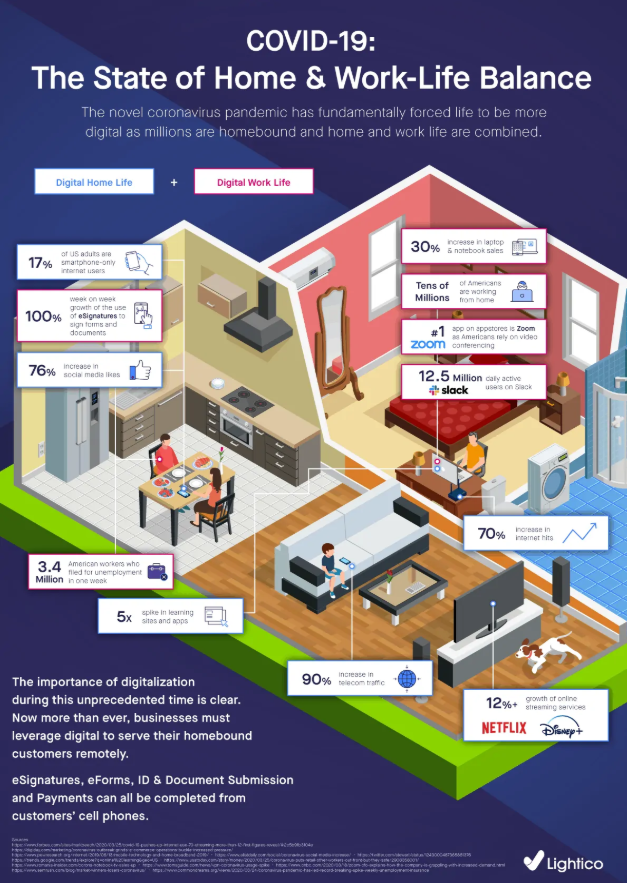
Home and Work-Life Balance
Ways To Battle Employee Stress
The key to learning how to manage stress at work so to keep it at a healthy level and make sure it doesn’t become overwhelming. There are warning signs that you’re experiencing too much stress at work such as:
Feeling anxious
Irritable or depressed.
Fatigue
Headaches
Social withdrawal
Apathy or loss of interest at work
Trouble sleeping
And problems concentrating
We’ve got a few simple ideas that could help reduce the employee stress at your business.
Form Positive Relationships
Share your thoughts and get things off your chest.
Develop Friendships with coworkers
Lean on your friends and family for support
Start Exercising or Exercise More
Exercise lifts your mood, increases energy, and sharpens focus.
Shoot for at least 30 minutes of activity on most days.
Go for walks throughout the day to de-stress.
Eat Healthy and Nutritious Foods
Reduce your sugar consumption to avoid energy crashes.
Eat more Omega-3 fatty acids for improved mood.
Avoid stimulants like caffeine or nicotine.
Get Enough Sleep
Aim for 8 hours of sleep each nights.
Turn off screens 1 hour before you want to go to bed.
Prioritize and Organize
Plan regular breaks throughout your day.
Prioritize your most important tasks and projects earlier in the day.
Delegate the things you don’t have to do yourself.
Kick Your Bad Habits
Resist trying to be perfect with everything.
Think positively and don’t beat yourself up over little things.
Don’t sweat over things out of control.
California’s Leader in Insurance and Risk Management
As one of the fastest growing agencies in California, GDI Insurance Agency, Inc. is able to provide its clients with the latest and greatest of what the insurance industry has to offer and much, much more.
We are headquartered in Turlock, CA, with locations across the heart of California’s Central Valley, Northern California and beyond to provide a local feel to the solutions and services we provide our clients. We pride ourselves on exceeding our client’s expectations in every interaction to make sure that our client’s know how much we value and appreciate their business. Contact us today 1-209-634-2929 for your comprehensive insurance quote!
CDC Guidance for Employees Following a COVID-19 Diagnosis or Exposure
On April 4, 2020, the Centers for Disease Control and Prevention (CDC) issued guidance for discontinuing home isolation following a COVID-19 diagnosis. The CDC also issued guidance for what essential workers should do following exposure to COVID-19.
This guidance should be used for informational purposes and should not supersede the instructions given to employees by their health care provider.
CDC Guidance for Discontinuing Isolation Following a COVID-19 Diagnosis
The decision to discontinue isolation* should be made in the context of local circumstances. Options now include both a time-since-illness-onset and time-since-recovery (non-test-based) strategy, and test-based strategy.
Persons with COVID-19 who have symptomsand were directed to care for themselves at home may discontinue isolation under the following conditions:
At least three days (72 hours) have passed since recovery defined as resolution of fever without the use of fever-reducing medications, and
Improvement in respiratory symptoms (e.g., cough or shortness of breath), and
At least seven days have passed since symptoms first appeared.
Test-based Strategy
Previous recommendations for a test-based strategy remain applicable; however, a test-based strategy is contingent on the availability of ample testing supplies and laboratory capacity as well as convenient access to testing. For jurisdictions that choose to use a test-based strategy, the recommended protocol has been simplified so that only one swab is needed at every sampling.
Individuals Who Have COVID-19 and Symptoms
Persons who have COVID-19 who have symptomsand were directed to care for themselves at home may discontinue isolation under the following conditions:
Resolution of fever without the use of fever-reducing medications, and
Improvement in respiratory symptoms (e.g., cough or shortness of breath), and
Negative results of an FDA Emergency Use Authorized molecular assay for COVID-19 from at least two consecutive nasopharyngeal swab specimens collected ≥24 hours apart*** (total of two negative specimens).
Individuals Who Have COVID-19 Without Symptoms
Persons with laboratory-confirmed COVID-19 who have not had any symptoms may discontinue
isolation when at least seven days have passed since the date of their first positive COVID-19 diagnostic test and have had no subsequent illness provided they remain asymptomatic. For three days following discontinuation of isolation, these persons should continue to limit contact (stay 6 feet away from others) and limit the potential of dispersal of respiratory secretions by wearing a covering for their nose and mouth whenever they are in settings where other persons are present. In community settings, this covering may be a barrier mask, such as a bandana, scarf or cloth mask. The covering does not refer to a medical mask or respirator.
CDC Guidance for Essential Workers Who Have Been Exposed to COVID-19
To ensure continuity of operations of essential functions, the CDC advises that critical infrastructure workers may be permitted to continue work following potential exposure to COVID-19, provided they remain asymptomatic and additional precautions are implemented to protect them and the community.
A potential exposure means being a household contact or having close contact within 6 feet of an individual with confirmed or suspected COVID-19. The time frame for having contact with an individual includes the period of time of 48 hours before the individual became symptomatic.
Employers of critical infrastructure workers who have had an exposure but remain asymptomatic should adhere to the following practices prior to and during their work shift:
Prescreen—Measure the employee’s temperature and assess symptoms prior to them starting work. Ideally, temperature checks should happen before the individual enters the facility.
Practice regular monitoring—As long as the employee doesn’t have a temperature or symptoms, they should be advised to self-monitor under the supervision of their employer’s occupational health program.
Wear a mask—Require the employee to wear a face mask at all times while in the workplace for 14 days after last exposure. Employers can issue facemasks or can approve employees supplied cloth face coverings in the event of shortages.
Social distance—Ensure that the employee maintains 6 feet of distance from others and practices social distancing as work duties permit in the workplace.
Disinfect and clean workspaces—Clean and disinfect all areas such as offices, bathrooms, common areas and shared electronic equipment routinely.
If the employee becomes sick during the day, they should be sent home immediately. Surfaces in their workspace should be cleaned and disinfected. Information on persons who had contact with the ill employee during the time the employee had symptoms and two days prior to symptoms should be compiled. Others at the facility with close contact within 6 feet of the employee during this time would be considered exposed.
For more information regarding the CDC’s guidance, click here.
California’s Leader in Insurance and Risk Management
As one of the fastest growing agencies in California, GDI Insurance Agency, Inc. is able to provide its clients with the latest and greatest of what the insurance industry has to offer and much, much more.
We are headquartered in Turlock, CA, with locations across the heart of California’s Central Valley, Northern California and beyond to provide a local feel to the solutions and services we provide our clients. We pride ourselves on exceeding our client’s expectations in every interaction to make sure that our client’s know how much we value and appreciate their business. Contact us today 1-209-634-2929 for your comprehensive business insurance quote!
Coronavirus Recording and Reporting Under OSHA Rules
The Occupational Safety and Health Act (the Act) requires employers to report and record work-related injuries and illnesses. The Occupational Safety and Health Administration (OSHA) has indicated that COVID-19 infections are recordable injuries if they are work-related and they meet the Act’s recording criteria. Recording requirements apply only to employers with more than 10 employees who are not in an exempt, low-risk industry.
In addition, employers must report incidents that result in an employee’s fatality within eight hours. Incidents that result in inpatient hospitalization, amputation or loss of an eye must be reported within 24 hours. This Compliance Overview presents a summary of the reporting and recording requirements that will most likely apply to coronavirus cases in the United States. For additional information on OSHA reporting and recording requirements please contact GDI Insurance Agency, Inc. or visit the OSHA website.
An injury or illness is work-related if an event or exposure in the work environment either caused or contributed to the resulting condition or significantly aggravated a preexisting injury or illness. Work-relatedness is presumed for events or exposures in the work environment.
Recording Criteria
Work-related COVID-19 cases are recordable if they:
Result in loss of consciousness, days away from work, restricted work or transfer to another job;
Require medical treatment beyond first aid;
Are a diagnosed case of cancer, chronic irreversible disease, fractured or cracked bones or teeth, and punctured eardrums; or
OSHA has clarified that COVID-19 can be a recordable illness if a worker is infected as a result of performing their work-related duties. Employers can use the graphic on the right to determine whether incidents should be recorded under the Act.
However, employers are only responsible for recording cases of COVID-19 if all of the following are met:
The case is a confirmed case of COVID-19 (see CDC information on persons under investigation and presumptive positive and laboratory-confirmed cases of COVID-19);
The case is work-related, as defined by 29 CFR 1904.5; and
The case involves one or more of the general recording criteria set forth in 29 CFR 1904.7 (e.g., medical treatment beyond first aid, or days away from work).
OSHA’s definition of a recordable illness includes “both acute and chronic illnesses, such as, but not limited to, a skin disease, respiratory disorder or poisoning.” This definition is limited to abnormal conditions or disorders that exclude the common cold and the seasonal flu. This can make it difficult when employees show up to work with coronavirus-like symptoms, such as a high fever or coughing. For this reason, employers should wait until they have a confirmed COVID-19 diagnosis before starting a recordability analysis.
Reporting COVID-19 Cases
As mentioned above, COVID-19 cases must be reported if they are work-related and result in a fatality (within eight hours), inpatient hospitalization, amputation or loss of an eye (within 24 hours). The reporting periods begin as soon as the employer learns about the work-related incident, even if there is a delay between the time the incident takes place and the time the incident is reported to the employer.
If the OSHA area office is closed, employers are expected to report these incidents by phone at 1-800-321-OSHA (6742) or the reporting application located on OSHA’s public website at www.osha.gov. OSHA reports must include the following information:
The establishment name;
The location of the work-related incident;
The time of the work-related incident;
The type of reportable event (i.e., fatality, inpatient hospitalization, amputation or loss of an eye);
The number of employees who suffered a fatality, inpatient hospitalization, amputation or loss of an eye;
The names of the employees who suffered a fatality, inpatient hospitalization, amputation or loss of an eye;
The employer’s contact person and his or her phone number; and
A brief description of the work-related incident.
Inpatient Hospitalizations
An inpatient hospitalization is a formal admission to the inpatient service of a hospital or clinic for care or treatment. Admissions that are strictly for observation or diagnostic testing are not reportable.
Delayed Reporting
Employers must report fatalities to OSHA if they occur within 30 days of the work-related incident.
Inpatient hospitalizations, amputations and loss of an eye must be reported even if they take place within 24 hours of the work-related incident.
California’s Leader in Insurance and Risk Management
As one of the fastest growing agencies in California, GDI Insurance Agency, Inc. is able to provide its clients with the latest and greatest of what the insurance industry has to offer and much, much more.
We are headquartered in Turlock, CA, with locations across the heart of California’s Central Valley, Northern California and beyond to provide a local feel to the solutions and services we provide our clients. We pride ourselves on exceeding our client’s expectations in every interaction to make sure that our client’s know how much we value and appreciate their business. Contact us today 1-209-634-2929 for your comprehensive insurance quote!
IRS Issues Guidance on Tax Credits for Coronavirus Paid Leave
Small and midsize employers may begin using two new refundable payroll tax credits to obtain reimbursement for the costs of providing coronavirus-related leave to their employees, the U.S. Department of Labor (DOL) and Internal Revenue Service (IRS) announced on March 20, 2020. According to IRS Notice 2020-12, these credits are available for qualified leave wages paid for the period beginning April 1, 2020, and ending Dec. 31, 2020.
This relief is provided under the Families First Coronavirus Response Act (the Act), which was enacted on March 18, 2020. The Act provides funds for employers with fewer than 500 employees to provide paid leave, either for their employees’ own health needs or to care for their family members. The Act aims to help employers keep workers on their payrolls while ensuring that workers are not forced to choose between their paychecks and the public health measures needed to combat the coronavirus (COVID-19). This Compliance Bulletin provides the DOL and IRS’ announcement
Action Steps
Employers should become familiar with their obligations to provide paid leave to employees under the Act and with the IRS’ guidance regarding tax credits for reimbursement. Employers should also monitor the IRS’ Coronavirus Tax Relief website for additional guidance, which is expected to be released in the near future, and:
Closely monitor the CDC, WHO and state and local public health department websites for information on the status of the coronavirus; and
Consider measures that can help prevent the spread of illness, such as allowing employees flexible work options like working from home.
Key Takeaways
Paid Sick Leave for Workers
For COVID-19 related reasons, employees receive up to 80 hours of paid sick leave and expanded paid child care leave when employees’ children’s schools are closed or child care providers are unavailable.
Complete Coverage
Employers may receive 100% reimbursement for paid leave under the Act.
Health insurance costs are also included in the credit.
Employers face no payroll tax liability.
Self-employed individuals may receive an equivalent credit.
Fast Funds
Reimbursement is intended to be quick and easy to obtain.
An immediate dollar-for-dollar tax offset against payroll taxes will be provided.
Where a refund is owed, the IRS intends to send the refund as quickly as possible.
Small Business Protection
Employers with fewer than 50 employees may be eligible for an exemption from the requirements to provide leave to care for a child whose school is closed, or because child care is unavailable in cases, if viability of their business is threatened.
Easing Compliance
Requirements subject to 30-day non-enforcement period for good faith compliance efforts.
To take immediate advantage of the paid leave credits, businesses can retain and access funds that they would otherwise pay to the IRS in payroll taxes. If those amounts are not sufficient to cover the cost of paid leave, employers can seek an expedited advance from the IRS by submitting a streamlined claim form (which is expected to be released this week).
Background
The Act provides paid sick leave and expanded family and medical leave for COVID-19 related reasons and creates the refundable paid sick leave credit and the paid child care leave credit for eligible employers. Eligible employers are businesses and tax-exempt organizations with fewer than 500 employees that are required to provide emergency paid sick leave and emergency paid family and medical leave under the Act. Eligible employers will be able to claim these credits based on qualifying leave they provide between the effective date and Dec. 31, 2020. Equivalent credits are available to self-employed individuals based on similar circumstances.
Paid Leave
The Act provides that employees of eligible employers can receive two weeks (up to 80 hours) of paid sick leave at 100% of the employee’s pay where the employee is unable to work because the employee is quarantined or experiencing COVID-19 symptoms and seeking a medical diagnosis. An employee who is unable to work because of a need to care for an individual subject to quarantine, to care for a child whose school is closed or child care provider is unavailable for reasons related to COVID-19, or if the employee is experiencing substantially similar conditions as specified by the U.S. Department of Health and Human Services can receive two weeks (up to 80 hours) of paid sick leave at two-thirds the employee’s pay. An employee who is unable to work due to a need to care for a child whose school is closed, or child care provider is unavailable for reasons related to COVID-19, may in some instances receive up to an additional 10 weeks of expanded paid family and medical leave at two-thirds of the employee’s pay.
Paid Sick Leave Credit
For an employee who is unable to work because of coronavirus quarantine or self-quarantine or has coronavirus symptoms and is seeking a medical diagnosis, eligible employers may receive a refundable sick leave credit for sick leave at the employee’s regular rate of pay, up to $511 per day and $5,110 in the aggregate, for a total of 10 days.
For an employee who is caring for someone with coronavirus, or is caring for a child because the child’s school or child care facility is closed, or for whom the child care provider is unavailable due to the coronavirus, eligible employers may claim a credit for two-thirds of the employee’s regular rate of pay, up to $200 per day and $2,000 in the aggregate, for up to 10 days. Eligible employers are entitled to an additional tax credit based on costs to maintain health insurance coverage for the eligible employee during the leave period.
Child Care Leave Credit
In addition to the sick leave credit, for an employee who is unable to work because of a need to care for a child whose school or child care facility is closed or whose child care provider is unavailable due to the coronavirus, eligible employers may receive a refundable child care leave credit. This credit is equal to two-thirds of the employee’s regular pay, capped at $200 per day or $10,000 in the aggregate. Up to 10 weeks of qualifying leave can be counted towards the child care leave credit. Eligible employers are entitled to an additional tax credit determined based on costs to maintain health insurance coverage for the eligible employee during the leave period.
Prompt Payment for the Cost of Providing Leave
When employers pay their employees, they are required to withhold from their employees’ paychecks federal income taxes and the employees’ share of Social Security and Medicare taxes. The employers then are required to deposit these federal taxes, along with their share of Social Security and Medicare taxes, with the IRS and file quarterly payroll tax returns (Form 941 series) with the IRS.
Under guidance expected to be released this week, eligible employers who pay qualifying sick or child care leave will be able to retain an amount of the payroll taxes equal to the amount of qualifying sick and child care leave that they paid, rather than deposit that amount with the IRS.
The payroll taxes that are available for retention include withheld federal income taxes, the employee share of Social Security and Medicare taxes, and the employer share of Social Security and Medicare taxes with respect to all employees.
If there are not sufficient payroll taxes to cover the cost of qualified sick and child care leave paid, employers may file a request for an accelerated payment from the IRS. The IRS expects to process these requests in two weeks or less. The details of this new, expedited procedure are expected to be announced this week.
Examples
If an eligible employer paid $5,000 in sick leave and is otherwise required to deposit $8,000 in payroll taxes, including taxes withheld from all its employees, the employer could use up to $5,000 of the $8,000 of taxes it was going to deposit for making qualified leave payments. The employer would only be required under the law to deposit the remaining $3,000 on its next regular deposit date.
If an eligible employer paid $10,000 in sick leave and was required to deposit $8,000 in taxes, the employer could use the entire $8,000 of taxes in order to make qualified leave payments and file a request for an accelerated credit for the remaining $2,000.
Equivalent child care leave and sick leave credit amounts are available to self-employed individuals under similar circumstances. These credits will be claimed on their income tax return and will reduce estimated tax payments.
Small Business Exemption
Employers with fewer than 50 employees may be eligible for an exemption from the leave requirements relating to school closings or child care unavailability where these requirements would jeopardize their businesses’ ability to continue. This exemption will be available in circumstances involving jeopardy to the viability of an employer’s business as a going concern. The DOL will provide emergency guidance and rulemaking to clearly articulate this standard.
Non-Enforcement Period
The DOL plans to issue a temporary non-enforcement policy that provides a time period for employers to come into compliance with the Act. Under this policy, the DOL will not bring an enforcement action against any employer for violations of the Act as long as the employer has acted reasonably and in good faith to comply with the Act. The DOL will instead focus on compliance assistance during the 30-day period.
California’s Leader in Insurance and Risk Management
As one of the fastest growing agencies in California, GDI Insurance Agency, Inc. is able to provide its clients with the latest and greatest of what the insurance industry has to offer and much, much more.
We are headquartered in Turlock, CA, with locations across the heart of California’s Central Valley, Northern California and beyond to provide a local feel to the solutions and services we provide our clients. We pride ourselves on exceeding our client’s expectations in every interaction to make sure that our client’s know how much we value and appreciate their business. Contact us today 1-209-634-2929 for your comprehensive insurance quote!
In response to the American economy reeling from the coronavirus (COVID-19) pandemic, the federal government recently signed into law the Coronavirus Aid, Relief and Economic Security Act (CARES Act). Among other provisions, the CARES Act provides businesses suffering under the debilitating effects of the pandemic with unprecedented access to emergency loans. This document will serve as an overview of the loan programs available.
How Does the CARES Act Address Small Business Loans?
The CARES Act is the largest economic stimulus measure in modern history and promises to provide help for struggling American families and businesses. Specifically, the Act includes the following provisions:
The Act includes nearly $350 billion for a federal small business loan program called the Paycheck Protection Program. The program is designed to get cash in the hands of suffering small businesses quickly, with less stringent eligibility requirements than the existing U.S. Small Business Association (SBA) loan programs. Paycheck Protection Program loans are designed to incentivize business owners to keep employees on payroll.
In addition to businesses already eligible for SBA programs, most businesses with 500 or fewer employees are now eligible for disaster loans of up to $2 million for working capital. Those businesses will also be eligible for an emergency cash advance of $10,000 within days of making the application, which is not repayable even if their loan application is denied.
Overview of CARES Act Small Business Loan Provisions
As noted above, the CARES Act provides two main avenues for obtaining a business loan:
Through the Paycheck Protection Program
Through the SBA as a disaster loan
Below you will find an overview of the eligibility requirements, key loan terms, and how to apply for each program.
Paycheck Protection Program Loans
The CARES Act allocated $350 billion to help small businesses keep workers employed amid the pandemic and economic downturn. Included in the CARES Act was the Paycheck Protection Program, which provides 100% federally guaranteed loans to small businesses, through Jun. 30, 2020. Importantly, these loans may be forgiven if borrowers maintain their payrolls during the crisis. Though information on the program continues to be rolled out, the following is an overview of information available now:
Eligibility
You are eligible for a loan under this program if you are:
A small business that was in operation on Feb. 15, 2020, with fewer than 500 employees (The 500-employee threshold includes all employees: full-time, part-time and any other status.)
A small business that otherwise meets the SBA’s size standard
A 501(c)(3) with fewer than 500 employees
An individual who operates as a sole proprietor
An individual who operates as an independent contractor
An individual who is self-employed and who regularly carries on any trade or business
A tribal business concern that meets the SBA size standard
A 501(c)(19) Veterans Organization that meets the SBA size standard
Terms of the Loan
The terms of a Paycheck Protection Program loan are as follows:
The amount of a Paycheck Protection Program loan available to each borrower is 2.5 times the borrower’s average monthly payroll costs, not to exceed $10 million.
Paycheck Protection Program loans require no collateral, have a maximum 10-year term, and an interest rate of no more than 4%.
The loans are available to eligible companies to be used for the following costs incurred from Feb. 15, 2020 through Jun. 30, 2020: payroll (including salary, wage, parental, family, medical or sick leave, and more); health care benefits and related insurance premiums; employee compensation; mortgage interest obligations; and rent and utilities.
A borrower of a Paycheck Protection Program loan is eligible for loan forgiveness equal to the amount spent during the eight-week period after the date of the original loan for rent on a leasing agreement, payroll costs (including wages for USA employees capped at $100,000 per employee), mortgage interest and utilities. The amount forgiven may be reduced if the borrower reduces the number of employees, or salaries and wages of employees. Borrowers must apply through their lender for forgiveness on the loan.
How to Apply for a Paycheck Protection Program Loan
The application has been posted on the Treasury Department’s CARES Act resource page. The SBA has a network of 1,800 approved lenders that process small business loans. If you are interested in a Paycheck Protection Program loan, you should first contact your bank to see if it is an SBA-approved lender. If your bank is not an SBA-approved lender, you can contact the SBA to find one.
SBA Economic Injury Disaster Loans
Another option for small businesses is the SBA’s existing Economic Injury Disaster Loan (EIDL) Program, which was expanded by the CARES Act and provides for longer-term loans with favorable borrowing terms. Companies in all 50 states, District of Columbia, and some U.S. territories are typically eligible for EDIL loans relating to economic injury caused by the COVID-19 pandemic, and will be available until Dec. 31, 2020.
Eligibility
The CARES Act expanded EIDL loan eligibility for the period between Jan. 31, 2020, and Dec.
31, 2020, to include:
Businesses with 500 or fewer employees
Sole proprietorships and independent contractors with or without employees
Private nonprofits and cooperatives
Tribal small business concerns and ESOPs with 500 or fewer employees
If your business meets the aforementioned requirements and your revenues have suffered substantial economic injury from COVID-19, your business is eligible no matter your line of business.
Terms of the Loan
The terms of an EIDL loan are outlined below:
The amount of an EIDL loan available to each borrower is the business’s actual economic injury as determined by the SBA, not to exceed $2 million.
EIDL loans under the CARES Act do not require personal guarantees for loans up to $200,000, but the SBA will take a collateral interest in your business’s assets to the extent available.
The interest rate on EIDL loans is 3.75% fixed for small businesses and 2.75% for nonprofits. EIDL loans have up to a 30-year term. Specific terms will be determined on a case-by-case basis, based upon each borrower’s ability to repay the loan.
EIDL loans may be used for payroll, debts and to pay obligations that cannot be met due to the pandemic.
Your business may be approved for an EIDL loan based on credit score alone, without being required to submit tax returns.
The CARES Act also permits applicants to request an advance of up to $10,000 which may be used to keep employees on payroll, to pay for sick leave, meet increased production costs, or pay business obligations. If you apply, the advance should be paid to your business within three days. This advance, available backdated from Jan.31, 2020 to Dec. 31, 2020, is not required to be repaid even if your application is denied. To access this advance, borrowers must first apply for an EIDL and then request the advance.
How to Apply for an SBA Economic Injury Disaster Loan
EIDL loans are available directly from the SBA. They have introduced a streamlined application process, which you can access here. Additionally, SBA resource partners are available to help guide you through the EIDL application process. You can find the nearest Small Business Development Center (SBDC), Women’s Business Center, or SCORE mentorship chapter here.
What’s Next?
It is clear that both Paycheck Protection Program loans and SBA EIDL loans provide very favorable terms to prospective borrowers. Eligible small businesses who have been economically impacted by the COVID-19 pandemic would be wise to consider taking advantage of such programs.
Businesses interested in the Paycheck Protection Program loans should consult with their banker(s). In the meantime, those also interested in the EIDL loans should evaluate with its advisors whether they are eligible. If so, businesses can consider gathering all relevant company documents and financial information that borrowers would ordinarily expect a lender to want to review (e.g., payroll information).
As the pandemic develops and the CARES Act provisions are rolled out, look for more relevant guidance from GDI Insurance Agency, Inc. in the near future.
California’s Leader in Insurance and Risk Management
As one of the fastest growing agencies in California, GDI Insurance Agency, Inc. is able to provide its clients with the latest and greatest of what the insurance industry has to offer and much, much more.
We are headquartered in Turlock, CA, with locations across the heart of California’s Central Valley, Northern California and beyond to provide a local feel to the solutions and services we provide our clients. We pride ourselves on exceeding our client’s expectations in every interaction to make sure that our client’s know how much we value and appreciate their business. Contact us today 1-209-634-2929 for your comprehensive business insurance quote!
Protecting Your Construction Workers from Coronavirus
The coronavirus
(COVID-19) outbreak has impacted a number of businesses across a variety of
industries, forcing them to rethink their daily operations to ensure the safety
of their employees and the general public. This is no different for
construction firms, where multiple contractors and tradespeople on a job site
may be working in the same space at any one time. In these instances, just one misstep
can lead to the quick spread of COVID-19, jeopardizing the well-being of
workers.
To help slow the
spread of COVID-19 and safeguard your staff, consider the strategies highlighted
in this Construction Risk Insights.
COVID-19 Safety Tips for Construction Firms
When it comes to
COVID-19, discouraging sick employees from reporting to work and encouraging
social distancing are the two of the most effective methods for protecting your
workers:
Discouraging sick employees from reporting to work—Above all, any
employee who is experiencing symptoms of COVID-19 (e.g., fever, cough,
shortness of breath, sore throat, runny nose, body aches, chills or fatigue)
should stay home. Individuals experiencing such symptoms should also be
instructed to consult guidance from the Centers for Disease Control and Prevention (CDC) on
seeking medical care.
Encouraging social distancing—Social distancing is the
practice of deliberately increasing the physical space between people to avoid
spreading illness. In terms of COVID-19, social distancing best practices for
construction businesses can include:
Avoiding gatherings of 10
or more people
Keeping at least 6
feet of distance from other people
Hosting meetings virtually when possible
Limiting the number of people on the jobs site
to essential personnel only
Encouraging staff to work from home when
possible
Discouraging people from shaking hands
Beyond these
recommendations, there are a number of specific job site and office precautions
construction firms should consider. Specifically, to help prevent the spread of
COVID-19, businesses should:
Communicate key CDC guidance to their workers on how to stay safe from COVID-19. Helpful resources include the following webpages:
Post posters and other signage that encourage workers to stay home when they’re sick and educate them on hygiene best practices to help prevent the spread of COVID-19. Sample posters from the CDC can be found here.
Instruct employees
to practice good hygiene. Employees should clean their hands often, either with
an alcohol-based hand sanitizer or soap and water. Hand sanitizers should
contain at least 60%-95% alcohol, and employees should wash their hands with
soap for at least 20 seconds. It’s also a good idea to strategically place hand
sanitizer and hand-washing stations around the job site.
Instruct employees
to:
Avoid congregating,
and keep their distance from other workers where possible.
Avoid sharing tools
and personal protective equipment (PPE).
Clean reusable PPE
per the original manufacturer’s recommendation before every use. Used PPE must
be disposed of properly.
Utilize disposable
gloves as appropriate, and wash their hands after they’re done with them.
Change their clothes
before they get home. Dirty clothes should be washed using hot water and
laundry sanitizer.
Ensure the work
environment is cleaned regularly. This can involve sanitizing doorknobs,
keyboards, tools, reusable supplies and equipment.
Avoid using a common
water cooler. For increased safety, provide employees with disposable plastic
water bottles or instruct them to bring their own.
Avoid scheduling
multiple tradespeople at once. This should help limit the amount of individuals
on the job site at once.
Sanitize portable
toilets frequently.
Avoid cleaning techniques
that could generate bioaerosols.
Continued Safety
While the strategies highlighted in this document can help you protect your workers from COVID-19, it’s important to follow CDC guidance at all times. For more information, click here.
California’s Leader in Insurance and Risk Management
As one of the fastest growing agencies in California, GDI Insurance Agency, Inc. is able to provide its clients with the latest and greatest of what the insurance industry has to offer and much, much more.
We are headquartered in Turlock, CA, with locations across the heart of California’s Central Valley, Northern California and beyond to provide a local feel to the solutions and services we provide our clients. We pride ourselves on exceeding our client’s expectations in every interaction to make sure that our client’s know how much we value and appreciate their business. Contact us today 1-209-634-2929 for your comprehensive Contractor insurance quote!
We use cookies to optimize our website and our service.
Functional cookies
Always active
The technical storage or access is strictly necessary for the legitimate purpose of enabling the use of a specific service explicitly requested by the subscriber or user, or for the sole purpose of carrying out the transmission of a communication over an electronic communications network.
Preferences
The technical storage or access is necessary for the legitimate purpose of storing preferences that are not requested by the subscriber or user.
Statistics
The technical storage or access that is used exclusively for statistical purposes.The technical storage or access that is used exclusively for anonymous statistical purposes. Without a subpoena, voluntary compliance on the part of your Internet Service Provider, or additional records from a third party, information stored or retrieved for this purpose alone cannot usually be used to identify you.
Marketing
The technical storage or access is required to create user profiles to send advertising, or to track the user on a website or across several websites for similar marketing purposes.