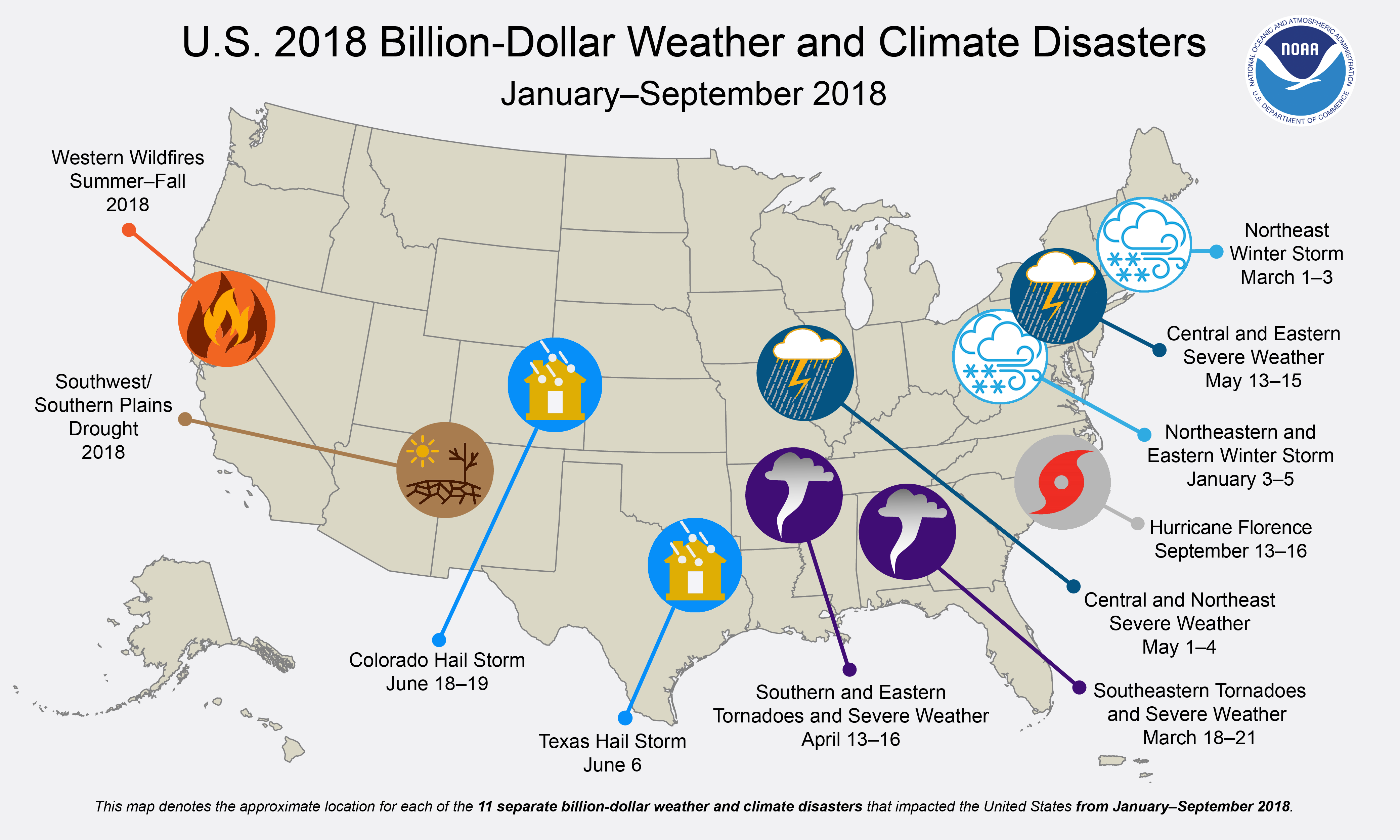
According to National Centers for Environmental Information (NCEI), in 2018 (as of October 9), there have been 11 weather and climate disaster events with losses exceeding $1 billion each across the United States. These events included 1 drought event, 6 severe storm events, 1 tropical cyclone event, 1 wildfire event, and 2 winter storm events. Overall, these events resulted in the deaths of 105 people and had significant economic effects on the areas impacted. We’ve got details on natural disasters and how to help your business recover.
Rebuilding and Recovery For Your Business After Natural Disasters
Hurricane Florence recently exposed the eastern United States to devastating winds and flooding, and initial estimates put the cost of the damage at nearly $5 billion. But once a storm or other type of disaster passes, you aren’t necessarily out of danger. Water damage, persistent flooding, damaged utilities and other hazards can endanger the physical safety of your employees and customers. You also need to consider how even a small business interruption can threaten your business. Contact GDI Insurance Agency, Inc. for a comprehensive business insurance quote, to make sure you are properly covered in case of a natural disaster.
Here are some tips and resources you can use to recover and rebuild after natural disasters:
Check in with all of your employees, customers and other stakeholders to ensure they aren’t in immediate danger.
Prioritize any tasks that are critical to resuming your regular operations.
Keep your employees informed about the status of your recovery process at all times.
Pay attention to the weather forecast in order to monitor storm patterns and stay aware of any updated guidance from local officials.
Make sure it’s safe to enter your workplace, then carefully assess any damage by taking clear, detailed photos that can be used during the claims process.
Contact us at 209-634-2929 to determine your insurance coverage and start the process as soon as possible.
Visit the FEMA’s website for legal aid that can help you access state or federal recovery funds.
Review the effectiveness of your emergency and business continuity plans, and make any necessary revisions.
California’s Leader in Insurance and Risk Management
As one of the fastest growing agencies in California, GDI Insurance Agency, Inc. is able to provide its clients with the latest and greatest of what the insurance industry has to offer and much, much more.
Headquartered in Turlock, CA with locations across the heart of California’s Central Valley and beyond to provide a local feel to the solutions and services we provide our clients. We pride ourselves on exceeding our client’s expectations in every interaction to make sure that our client’s know how much we value and appreciate their business. Contact us today 1-209-634-2929 for your comprehensive business insurance quote!
Building a comprehensive safety culture is the best way to reduce illnesses and injuries, and their associated costs. But creating such a culture is not an overnight process or “flavor of the month” program. Instead, it is a multi-year, top management commitment that results in an organization with low accident rates, low turnover, low absenteeism and high productivity. This is a big-picture, long-term project. GDI Insurance Agency, Inc. has a full set of tools for your business to build a safe workplace. Contact us today 1-888-991-2929.
A robust safety culture has the following characteristics:
At the highest organizational level, there is a well-articulated commitment to safety. This translates into organization-wide values, beliefs, and behavioral norms.
Employees’ base compensation ties directly to their commitment to the safety culture. This commitment is assessed in regular performance reviews.
Safety takes precedence over everything else, even production and efficiency. Employees who err on the side of safety should be rewarded, even if a later review suggests that the additional safety measures or concerns were unnecessary.
Communication about safety occurs across all levels of the organization in a consistently open, unedited, and honest manner. If problems or errors are identified, they are eagerly communicated, recorded, and analyzed without anyone being “persecuted.”
Unsafe acts—the main cause of accidents—are rare.
Employees continuously learn and identify opportunities for process improvements that will decrease the likelihood of an accident.
The following sections explore in more detail some of the key components of a successful safety culture.
Why Bench Marking is Important for a Safe Workplace
It is difficult to just guess the quality of your safety culture. Therefore, it is important to benchmark where you are now, both in subjective terms and in objective, analytical measurements. By combining an analytical tracking system with a periodic, subjective culture survey, you can better understand the impact your efforts to improve the safety culture are having over time.
Hiring to Avoid Workplace Injuries
Due to preexisting medical conditions or limitations, some potential job candidates may be more prone to workplace injury.
It is a common misconception that the Americans with Disabilities Act (ADA) prevents you from asking any medical questions during the hiring process. However, according to the Department of Labor, there are actually three stages of employment: pre-employment, post-offer, but pre-placement (after the conditional offer of employment) and finally, employment. During the first and third stages, it is true that you cannot ask any medical questions. However, during the second phase (after a conditional offer of employment is extended) you can ask the applicant to fill out a medical questionnaire and/or take a medical exam. If, in medical opinion, the applicant is unfit for the job, you can withdraw the offer. It’s that simple. To avoid hiring your next workers’ compensation claim, there are two key processes you need to implement.
The Conditional Offer of Employment
The ADA says that employers cannot require a job applicant to provide medical information or undergo a medical exam until a conditional offer of employment is made. When a conditional offer is made you are essentially hiring the candidate. The only way an offer may be withdrawn prior to the effective date of employment is if, in medical opinion, the candidate will be unable to perform the job duties safely with reasonable accommodations.
The Medical Questionnaire/Exam
After you extend a conditional offer of employment, it is time to perform a medical screening of the candidate. If information emerges from the screening that indicates that the candidate will not be able to perform the job duties safely even with reasonable accommodations, then and only then can you withdraw the offer of employment.
Stay Out of Trouble with OSHA
OSHA most often shows up at your workplace in response to an employee complaint or serious accident. The best way to be prepared is to be in compliance. Not only does OSHA compliance help you avoid costly fines, it also ensures that safe work practices are being encouraged. Fortunately, some of the most common OSHA violations are also the easiest to address.
Postings
OSHA requires that employers display certain posters and notices in the workplace. Not all employers need to post every notice—some apply only to very specific industries or situations—but you need to know which notices you are required to post and do so.
Recordkeeping
OSHA also requires certain employers to track workplace injuries and illnesses, and report them periodically.
HAZCOM
OSHA’s Hazard Communication Standard states that employees must be made aware of all chemicals used in their workplace, the hazards they present and instruction for safe handling. This is accomplished with labels, safety data sheets (SDS), and employee information and training.
In addition to the three key areas of frequent OSHA violations, there is an easy way for you to identify the top violations in your specific industry. OSHA provides a searchable database of the most frequent OSHA violations by company size and Standard Industrial Classification (SIC) code.
Promoting the Health of Your Workers
As an employer, you bear many of the direct costs (such as medical claims) and the indirect costs (such as absenteeism and lowered productivity) of diseases, disorders and conditions that afflict your employees.
Research shows that you can avoid or reduce many of these costs by providing early behavioral and/or clinical interventions for your employees. Clinical preventive services include screenings and immunizations, as well as follow-up care. Behavioral interventions can include counseling and health promotion programs such as smoking cessation, weight management and physical activity initiatives.
Beyond what it does for them in their personal lives, improving your employees’ health has two fundamental and practical benefits for the health of your business.
Increased productivity
It is a simple fact that employees in good health are much more likely to be performing at optimal levels than employees in poor health.
Reduced health care costs
Employees with poor health use more health care resources and generate more claim costs than their healthy peers. Overall, you can expect to save about $3.50 in health care costs for every dollar you invest in effective health promotion.
Implementing a wellness program does not have to be an overwhelming task. In fact, you are more likely to have a successful program if you focus on a few key areas that are of interest to most employees and where results can be significant.
California’s Leader in Insurance and Risk Management
As one of the fastest growing agencies in California, GDI Insurance Agency, Inc. is able to provide its clients with the latest and greatest of what the insurance industry has to offer and much, much more.
With our headquarters in Turlock, CA plus locations across the heart of California’s Central Valley and beyond to provide a local feel to the solutions and services we provide our clients. We pride ourselves on exceeding our client’s expectations in every interaction to make sure that our client’s know how much we value and appreciate their business. Contact us today 1-209-634-2929 for your comprehensive business insurance quote!
Working through pain can cause serious injuries, potentially leaving you permanently partially or fully disabled. Even though sitting at a desk isn’t considered a high-risk situation for injury, small aches and pains can add up to cause more severe problems. That’s why it’s important to practice good ergonomics, which is the study of how you perform daily work tasks and correcting any trouble spots before any aches and pains due to repetitive motion, awkward postures or poor lifting techniques set in.
Muscles require periodic rest. One of the best ways to prevent injury is to take regular breaks from repetitive tasks
Results of Musculoskeletal Disorders
Musculoskeletal disorders can develop suddenly or over time, causing pain and resulting in lost time and pay at work. The most common pains come from strains in the neck, lower back, shoulders, elbows, wrists, hands and eyes due to one or more of four primary risk factors: awkward postures, excessive force, repetitive motion or contact stress. The way employees lift and move their bodies is a major contributing factor in various disorders.
About Your Workstation
The way your workstation is set up may determine your risk of developing a musculoskeletal disorder over time. Improper positioning in your workstation can cause various disorders due to reaching or straining unnecessarily. If you are regularly bending or twisting to do common tasks, your risk of developing a disorder is much higher. Static work in poor postures can have negative effects, too. However, if you follow several basic guidelines, you can prevent pain and injury. Ergonomics at work can significantly reduce your risks of serious injuries, potentially leaving you permanently partially or fully disabled.
GDI Insurance Agency, Inc. can help your business with establishing your ergonomics at work. Contact us today for more information 1-888-991-2929.
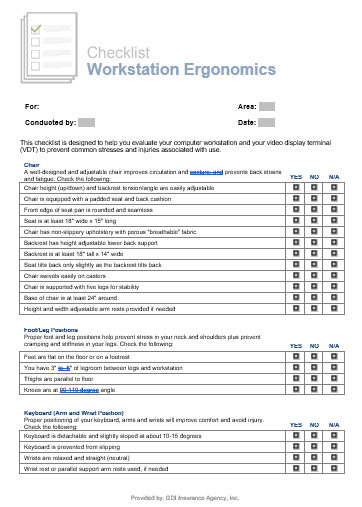
Download our Workstation Ergonomics Checklist!
Tips to improve comfort and ergonomics at work
Sitting at a computer for the majority of your workday can negatively affect your health if your workstation isn’t properly adjusted. Follow these suggestions to make your workstation work for you.
How to Adjust Your Desk Chair
Adjust the seat height so your feet are flat on the floor and your knees are equal to—or slightly lower than—your hips.
Adjust your armrests so that your shoulders are down and relaxed. If your armrests are in the way, remove them.
Sit in the chair with your hips positioned as far back as possible. Use a footrest if your feet don’t touch the floor.
Where Should My Monitor Placement Be?
Placing your monitor in an appropriate position helps prevent excessive fatigue, eyestrain, and neck or back pain.
Center and position the top of the monitor approximately 2 to 3 inches above seated eye level.
Sit at least an arm’s length away from the screen, making adjustments to suit your vision.
You can reduce glare by positioning your screen away from windows, adjusting blinds or using a filter.
Position source documents directly in front of you, between the monitor and the keyboard, using a copy stand.
How To Setup Your Keyboard and Mouse For Office Ergonomics
If your keyboard and mouse are not adjusted properly, it can lead to discomfort in your wrists, arms and shoulders.
Place the keyboard directly in front of you at a distance that allows your elbows to stay close to your body and your forearms approximately parallel with the floor.
Use the keyboard feet to adjust the tilt of your keyboard. If you sit in a forward or upright position, try tilting your keyboard away from you at a negative angle. If you are reclined, a slight positive tilt will help maintain a straight wrist position.
A wrist rest can help you to maintain neutral postures and pad hard surfaces, but resting on it while typing is not recommended.
Why It Is Important To Take a Break
Regardless of how well your workstation is set up, sitting still and working in the same posture for prolonged periods is not healthy. Try to change your working position frequently throughout the day.
Take a break or change tasks for at least 5 to 10 minutes after each hour of work. Try to get away from your desk during lunch breaks.
Avoid eye fatigue by resting and refocusing your eyes periodically.
Make small adjustments to your chair or backrest.
Warming Up Before Work
Moving the body in ways it is not ready to move and using muscle groups that haven’t been warmed up for work can be a major cause of pain. There is a real value in practicing basic stretching exercises for our hands, wrists, back and neck to prepare our bodies for work. Begin with your hands and wrists, stretching them thoroughly for the movements typically made at work. Stretch your neck gently from side to side and then from front to back. Stretch your back while sitting in a chair by bending your chin toward your knees.
Important Lifting Methods
When lifting, first take a good look at the load. If it is too awkward, too big or too heavy, ask for help. Lifting an item that is too big, simply because you are unwilling to ask for assistance, can result in unnecessary pain and lost wages.
Second, lift with your legs, not with your back. Your legs are your biggest muscles and are able to lift heavier objects. With a straight back, keep weights at shoulder level. Avoid bending at your waist, which can strain your back.
Third, avoid lifting and twisting in the same motion. Your first goal is to get the object off the ground. Once your legs are straight, you can move your legs instead of twisting your back.
Back belts do not allow you to lift more weight. Don’t ignore proper lifting principles. The only way to effectively prevent back injury is to follow the correct lifting procedure, with or without a back belt.
Get Involved
If you have any questions regarding ergonomics or your work area, let your manager know.
California’s Leader in Insurance and Risk Management
As one of the fastest growing agencies in California, GDI Insurance Agency, Inc. is able to provide its clients with the latest and greatest of what the insurance industry has to offer and much, much more.
With locations across the heart of California’s Central Valley and beyond to provide a local feel to the solutions and services we provide our clients. We pride ourselves on exceeding our client’s expectations in every interaction to make sure that our client’s know how much we value and appreciate their business. Contact us today 1-209-634-2929 for your comprehensive business insurance quote!
What Contractors Need To Know About Coverage, Safety and Service
You know that insurance is essential for your California construction business, but did you know that not all construction insurance brokers are the same? If you tend to compare policies based solely on price and coverage, then you are missing vital services that only select brokers can provide—services that will save you time and money. An expert broker in the construction insurance industry knows that contractors need the right coverages and services that include superior risk management, claims processing and underwriting service. Contact GDI Insurance Agency, Inc to experience a full service insurance broker 209-634-2929.
Risk Management Is Key
Most, if not all, brokers offer some type of risk management advice as part of their agency’s services. However, the quality and depth of their risk control offerings is the key differentiator. Many brokers will provide only general suggestions and generic safety programs. While those can be useful, a more comprehensive, in-depth risk control program is extremely advantageous for a contractor.
Rather than relying on general advice, brokers who specialize in the construction insurance and industry can give you tailored industry guidance. The most dedicated brokers will send a safety specialist to your worksite in order to observe your operations and create a customized risk control and safety program tailored to your unique business needs. Only after a broker understands your day-to-day needs and challenges can he or she provide meaningful solutions.
A good risk management program should emphasize safety as paramount. Worksite accidents are expensive, both in terms of claims costs and future premium increases—but also in hidden costs. You may not realize just how expensive an accident can be:
Loss of profits: Accidents may interrupt work for a time period or even cause projects to run late. In addition, property damage involved in the accident may be time consuming and costly to repair.
Soft costs: Accidents may also require manpower to be redirected away from completing construction work to manage other responsibilities, such as additional paperwork, meeting with law enforcement or following up on investigations.
Market image: No one wants to hire a contractor prone to accidents, and one or two high-profile accidents could give your firm a bad reputation. Your safety track record is an important component to winning future bids.
Psychological impact: Other employees often have strong reactions following a serious or fatal accident. They may blame the company for not protecting their co-worker or may simply need time to deal with the trauma they witnessed or were a part of. This could impact your retention and ability to hire quality workers in the future.
These examples show just how important an effective safety program is, and a good broker will help you develop comprehensive safety initiatives to address any and all risks your company faces. Remember, too, that certain safety initiatives are mandated by law. Plus, many construction insurance policies will only pay claims if you can demonstrate that your company follows strict health and safety guidelines.
What To Do When I Have A Claim
The aftermath of an accident can be a stressful and overwhelming time, and you need a broker who is quick, efficient and knowledgeable with handling claims and helping you manage the accident site. You may want to consider a broker whose agency has a local office, to ensure they are familiar with your geographic area and local nuances that can affect claims processing and settlement. In addition, your broker should have extensive experience with construction insurance industry claims, so that your claim is properly handled. A local broker can also prove more responsive after an accident. You may have to deal with the media or law enforcement officials, and your construction insurance representative can help manage that situation. Some agencies will insist on waiting for a claim to be processed before visiting the site, but dedicated brokers will be there immediately to help with preserving evidence, serving as a liaison and managing the accident site.
Why Type of Insurance Coverage Do I Need?
There are many types of coverage that a contractor needs, and only agents that specialize in the construction insurance industry will be able to ensure that you are fully covered. If your broker takes the time to learn and understand your business operations and the unique risks of your company, he or she will be able to put together a comprehensive coverage package.
You may benefit from professional liability, surety coverage or bonds and more.
Your broker should know how to coordinate your various policies to ensure that there are no gaps in coverage. When a claim occurs, a good broker will help liaise with the carriers to sort out who will handle the claim. Some policies may have exclusions that your broker should be aware of and can address with an alternative solution, such as a general liability policy that has a pollution exclusion. If you work in multiple states, that also may have implications for your contractor insurance coverages. Your broker must understand and manage all of these aspects to ensure that you are appropriately covered.
Experience the GDI Difference!
We don’t just make a sale and leave you hanging, here are just a few of the added value items we provide:
We review your contracts
Review your certificates of insurance
Additional insured endorsements
Put on classes for your staff on these topics
Full OSHA compliant safety programs
At GDI Insurance Agency, Inc. we provide this comprehensive protection plan whether you are a sole proprietor performing general remodeling, a specialty trade or artisan contractor, or the largest general construction firm in the industry
Another risk issue in the construction industry is subcontractors. You should be able to count on your broker to advise you on how to handle that relationship to best protect yourself. For instance, you may be sued for mistakes made by a subcontractor. So, in addition to including an indemnity clause in your contract, you may want to require the subcontractor to add you to their commercial general liability policy as an additional insured. A good broker will also assist you in handling any claims that arise due to a subcontractor’s mistake, which can potentially be messy and confusing.
Underwriting Service
Underwriting can hold up the quoting process when putting together a coverage package. However, brokers who have relationships with carriers and underwriters they trust can work to ensure the quickest turnaround time for a quote. Though this behind-the-scenes exchange normally does not impact you directly, agents who work with reliable, responsive underwriters can save you time when quoting a renewal or new policy.
Obtaining insurance should be a strategic component of your business. Developing a comprehensive insurance program to support your unique business needs is not something just any broker can deliver. At GDI Insurance Agency, Inc., we specialize in construction insurance and our dedicated agents are committed to learning your business and developing a customized insurance and safety plan for you. Contact us today.
California’s Leader in Insurance and Risk Management
As one of the fastest growing agencies in California, GDI Insurance Agency, Inc. is able to provide its clients with the latest and greatest of what the insurance industry has to offer and much, much more.
With locations across the heart of California’s Central Valley and beyond to provide a local feel to the solutions and services we provide our clients. We pride ourselves on exceeding our client’s expectations in every interaction to make sure that our client’s know how much we value and appreciate their business. Contact us today 1-209-634-2929 for your comprehensive contractor insurance quote!
Many California business owners assume that their business is too small to be threatened by employee theft, or that all of their employees are honest and loyal. As a result, many businesses only take a passive approach to prevent fraud—responding to incidents of theft only when external sources, such as a tip from a coworker or police investigations, bring them to the company’s attention. However, investigations into employee theft clearly indicate that it occurs much more frequently than employers realize. By taking a few simple steps to ensure honest work practices, you can substantially reduce your risk.
What Are The Commonly Overlooked Theft Exposures
Employee fraud is a risk that businesses of all sizes need to take seriously. In a recent survey, the Association of Certified Fraud Examiners (ACFE) estimated that the annual global loss due to employee theft is approximately $3.7 trillion.
Though you may think that the majority of losses from employee theft occur at large corporations, the opposite is true. Approximately 80 percent of all cases of fraud occur at businesses with fewer than 100 employees, and 50 percent of cases occur at businesses with fewer than 25.
Small businesses can have increased exposures to acts of employee fraud because they often don’t have adequate safeguards in place. For example, a business where a single employee is responsible for accounting is a much easier target than another business with an entire accounting team.
What is the Difference Between Employee Theft and Embezzlement?
The important distinction between embezzlement and theft is that embezzlement involves property that was willingly entrusted to you by its lawful owner. This crime commonly occurs when an employee or a representative funnels company funds or property to their own personal account without the consent or knowledge of the employer.
What Are the Most Common Types of Employee Theft?
Physical Cash– money from cash registers, petty cash drawers or open safes
Company Supplies or Equipment– From pens or stationary to computers.
Merchandise- Physical products from your business.
Information- Customer lists, proprietary information or even Customer credit card or personal information.
Payroll- Falsification of time cards or not clocking out when not working.
Employee Theft Can Be Done By Anyone On Your Team
Even when businesses owners see their employees as a tightly knit team, they are still a considerable risk to your business. The ACFE found that long-term employees are more likely to steal from a business than new hires—making your long-term employees a larger exposure than you might realize. Additionally, only 5 percent of employees who commit fraud have been convicted of a similar incident in the past. As a result, you can’t rely on background checks or your employees’ work history to protect against theft.
You may hesitate to label your employees as a significant risk to your business—and certainly most, if not all of them, have your best interests in mind. However, you can’t afford to ignore such a significant risk. The ACFE estimates that 58 percent of businesses have no recovery of losses after a case of employee fraud, and a large financial loss could devastate your business.
Covering the Common Exposures
Since the loss during even a single instance of employee theft can be devastating, it’s vital to take a proactive approach and implement strategies that cover your exposures and deter would-be thieves. The most effective strategies are based on common theft exposures in order to cover the largest risks. In its survey, the ACFE found the following three common exposures:
A lack of internal controls to deter theft
A lack of consistent internal reviews
The possibility for an employee to override existing internal controls
Based on these findings there are a number of simple, effective strategies that you can use to deter thieves, reduce your business’s losses and maintain a positive workplace:
Employee support programs: When an employee steals from his or her workplace, some of the biggest motivating factors are financial and emotional stress. Formal or informal support programs can help employees identify other resources to rely on during a period of hardship.
Management review: A simple review of a business’s day-to-day activities can help identify exposure areas. For example, management should regularly ensure that these simple policies are followed:
Require two signatures on checks.
Review the payroll every quarter.
Retain and store accurate records of all sales, inventory checks and financial and bank statements.
Unannounced audits: A random audit can uncover an instance of employee fraud or inefficient work practices. These audits should not unduly target any employee, and should be conducted by at least two individuals.
Proactive data monitoring and analysis: Many instances of fraud can be caught early if suspicious actions are identified and analyzed. According to the ACFE, businesses that use proactive data monitoring reduce the losses attributed to employee theft by nearly 60 percent. Data monitoring could be as easy as establishing certain red flags—such as a large financial transfer or the unexplained absence of inventory—that would automatically be sent to management for review.
Employee hotline: Establishing an anonymous employee hotline can help you discover thefts earlier and limit your losses. You may have employees who are aware of wrongdoing but remain silent in order to protect their identity.
Don’t Face This Risk Alone
It can be difficult to know how to react if you ever find that an employee has stolen from you. However, you don’t have to face employee theft on your own.
The experts at GDI Insurance Agency, Inc.can help you react quickly and decisively to fraud. Additionally, we can help you purchase an employee theft insurance policy, contact legal counsel and provide you with additional resources to protect your business from theft. Contact us today 209-634-2929.
We use cookies to optimize our website and our service.
Functional cookies
Always active
The technical storage or access is strictly necessary for the legitimate purpose of enabling the use of a specific service explicitly requested by the subscriber or user, or for the sole purpose of carrying out the transmission of a communication over an electronic communications network.
Preferences
The technical storage or access is necessary for the legitimate purpose of storing preferences that are not requested by the subscriber or user.
Statistics
The technical storage or access that is used exclusively for statistical purposes.The technical storage or access that is used exclusively for anonymous statistical purposes. Without a subpoena, voluntary compliance on the part of your Internet Service Provider, or additional records from a third party, information stored or retrieved for this purpose alone cannot usually be used to identify you.
Marketing
The technical storage or access is required to create user profiles to send advertising, or to track the user on a website or across several websites for similar marketing purposes.