The coronavirus (COVID-19) pandemic has interrupted many businesses across the country. While it’s unclear how long COVID-19 will continue to affect organizations, many employers are looking to the future of employees returning to work. These details will help you build return to work plans.
Echoing the sentiments of public health officials, a return to normalcy won’t be like flipping a switch, but rather a gradual effort. In preparation for reopening your business and asking employees to come back to work, it’s imperative that your company thoughtfully constructs a return to work plan for its employees to keep everyone healthy and safe following the COVID-19 pandemic.
Please note that this article should be used for informational purposes only and should not supersede applicable state or local guidance. Additionally, please review any workplace-specific considerations, which could be more involved depending on the industry you operate in, when drafting your return to work plans.
Return to Work Plans: Introduction
A return to work plan is typically created to help reintegrate workers who have been injured or have been on leave. The plan includes details on how the worker will gradually return to work and any job-related specifics. Its purpose is to formalize steps for a safe and quick return to work.
There are many benefits of return to work plans for both the employer and the employee. Employers can enjoy increased employee engagement, proactive cost containment, reduced turnover, increased communication and improved morale with an established return to work plan. And it’s been proven that employees who go through return to work plans are able to get back to work quicker than those who don’t, meaning that employers will see increased productivity following an employee’s return to work.
Employees also benefit from return to work plans, as they feel supported by their employer, which increases their engagement and loyalty to the company. Going through a return to work plan also helps them get back to work faster and increases the likelihood that they feel secure and stable in their role.
The benefits of return to work plans are undeniable. While these plans are typically customized on an individual basis, you can use the basics of a return to work plan to build your company’s approach to asking employees to return to work following the COVID-19 pandemic.
COVID-19 Return to Work Plans
COVID-19 has caused many businesses to shut down or transition their employees to work from home, disrupting daily work life for many. As stay-at-home regulations are scaled back and all businesses are allowed to resume as normal, your employees will be asked to come back to work. While they may not be coming back from an injury or leave, you need to have a plan in place for all employees to safely and successfully return to work.
While you may need to tailor your organization’s COVID-19 return to work plan to employees’ specific needs (e.g., child care arrangements, caregiving responsibilities and health issues), having a generalized plan in place can help you safely reopen your business.
Your COVID-19 return to work plans should include the following:
Anticipated return to work date—With the uncertainty that COVID-19 has brought, it’s important to give clear information and dates when employees are to return to work whenever possible. Be sure to be flexible with your dates, though, as local and state orders are frequently updated.
Disinfecting and cleaning measures—Because COVID-19 can remain on surfaces long after they’ve been touched, it’s important that your business frequently cleans and disinfects the facility. Some best practices include:
Cleaning and disinfecting all frequently touched surfaces in the workplace, such as workstations, keyboards, telephones, handrails and doorknobs.
Discouraging workers from using other workers’ phones, desks, offices, or other tools and equipment, when possible. If necessary, clean and disinfect them before and after use.
Providing disposable wipes so that commonly used surfaces can be wiped down by employees before each use.
Social distancing protocol—Social distancing is the practice of deliberately increasing the physical space between people to avoid spreading illness. In terms of COVID-19, social distancing best practices for businesses can include:
Avoiding gatherings of 10 or more people
Instructing workers to maintain at least 6 feet of distance from other people
Hosting meetings virtually when possible
Limiting the number of people on the job site to essential personnel only
Discouraging people from shaking hands
Employee screening procedures—To keep employees safe, consider conducting screening procedures to identify potentially ill employees before they enter the office. The Equal Employment Opportunity Commission permits employers to measure employees’ body temperatures before allowing them to enter the worksite. Any employee screening should be implemented on a nondiscriminatory basis, and all information gleaned should be treated as confidential medical information under the Americans with Disabilities Act—specifically, the identity of workers exhibiting a fever or other COVID-19 symptoms should only be shared with members of company management with a true need to know. Be sure to notify employees that you will be screening them to avoid any surprises.
Employee safety training—Your return to work plan should include detailed safety training guidance to ensure that all employees understand how they can prevent the spread of COVID-19. Your plan should discuss the following safety training topics:
Respiratory etiquette and hand hygiene—Businesses should encourage good hygiene to prevent the spread of COVD-19. This can involve:
Providing tissues and no-touch disposal receptacles
Providing soap and water in the workplace
Placing hand sanitizers in multiple locations to encourage hand hygiene
Reminding employees to not touch their eyes, nose or mouth
Personal protective equipment (PPE)—PPE is equipment worn by individuals to reduce exposure to a hazard, in this case, CVOID-19. Businesses should focus on training workers on proper PPE best practices. Employees should understand how to properly put on, take off and care for PPE. Training material should be easy to understand and must be available in the appropriate language and literacy level for all workers.
Staying home when sick—Encourage employees to err on the side of caution if they’re not feeling well and stay home when they’re sick or are exhibiting common symptoms of COVID-19 (e.g., fever, cough or shortness of breath).
Mental health considerations—The COVID-19 pandemic has increased stress levels of employees across the country. It’s important that your return to work plan includes guidance for managing employee mental health concerns when employees return to work.
Process for individualized requests—Employees will be returning to work and facing different situations at home or with their health. Your return to work plan should include information about how employees can go about making individualized requests for changes to a return to work plan. Some may have underlying health conditions that put them at greater risk of severe illness with COVID-19, meaning they may not be able to fully return to work. Others may be facing unique child care arrangements due to schools and day cares being closed. Be flexible and compassionate in your response to individualized requests.
Your return to work plans should be tailored to your business’s unique needs and should follow local and state regulations. Reach out to GDI Insurance Agency, Inc. for assistance with creating a unique return to work plan for your organization.
Return to Work Considerations
Returning to work after the COVID-19 pandemic is likely to bring challenges to your organization. Some of the most common challenges that you’ll need to be prepared for include the following:
Changing worker priorities—If your organization asked its employees to work from home during the COVID-19 pandemic, employees may want to still enjoy work from home arrangements even after the office is reopened. Your organization should be prepared for an increased demand in work from home requests, and you may need to expand your pre-COVID-19 policies to meet this demand. In addition, prospective employees may ask about this benefit when they’re searching for a job within your company.
Updating the office layout—Due to social distancing protocols, your organization may need to reconfigure the office’s layout. Per the guidelines, employee workstations should be 6 feet apart to help prevent the spread of COVID-19.
Adapting to changing rules and regulations—Due to the nature of the COVID-19 pandemic, rules and regulations are constantly changing. You should be prepared to change your business practices if needed to maintain critical operations. This could involve identifying alternative suppliers, prioritizing existing customers or suspending portions of your operations.
Managing reputational effects—Given the scope of the COVID-19 pandemic and how much is still currently unknown about the situation, people may have strong opinions about your decision to reopen your business. You’ll need to be prepared for the reputational effects of reopening your business. By taking the steps to keep your employees and customers safe and healthy, you can manage reputational effects of opening after the pandemic.
Remember, reopening your business after the COVID-19 pandemic isn’t as simple as opening your doors. You’ll need to carefully evaluate each step of your reopening and gradually ask employees to return to work.
Continued Safety
The next phase of responding to the COVID-19 pandemic involves reopening your business. While this task may seem daunting, we’re here to help every step of the way. Contact GDI Insurance Agency, Inc. today to learn what actions you need to take to ensure your employees’ return to work is as seamless as possible.
California’s Leader in Insurance and Risk Management
As one of the fastest growing agencies in California, GDI Insurance Agency, Inc. is able to provide its clients with the latest and greatest of what the insurance industry has to offer and much, much more.
We are headquartered in Turlock, CA, with locations across the heart of California’s Central Valley, Northern California and beyond to provide a local feel to the solutions and services we provide our clients. We pride ourselves on exceeding our client’s expectations in every interaction to make sure that our client’s know how much we value and appreciate their business. Contact us today 1-209-634-2929 for your comprehensive insurance quote!
Easing Employee Stress During the COVID-19 Pandemic
As the number of confirmed cases increases daily, employees and their families are experiencing immense uncertainty. In times such as these, employees are looking for guidance wherever they can find it. Employers can help calm some of their employee stress by taking the following actions:
Acknowledge employee fears surrounding their jobs and the company, but also reassure them of their value to the company and the company’s desire to keep them as members of the team.
Be open with employees about management decisions and ask for suggestions to rectify problems.
Provide as much information as possible about the pandemic.
Highlight employee benefits that employees might not know about to relieve any financial stress.
Encourage employees to take advantage of any telehealth services to preserve their mental well-being.
Communicate the future of the business with employees often—in meetings, on the company intranet site, in newsletters and in blogs.
Be empathetic in your communications, as every employee’s situation may be different.
In these uncertain times, it’s imperative that you clearly communicate your business’s plans as frequently as possible. It’s not possible for you to control the pandemic, but it is possible for you to help ease the stress your employees are experiencing.
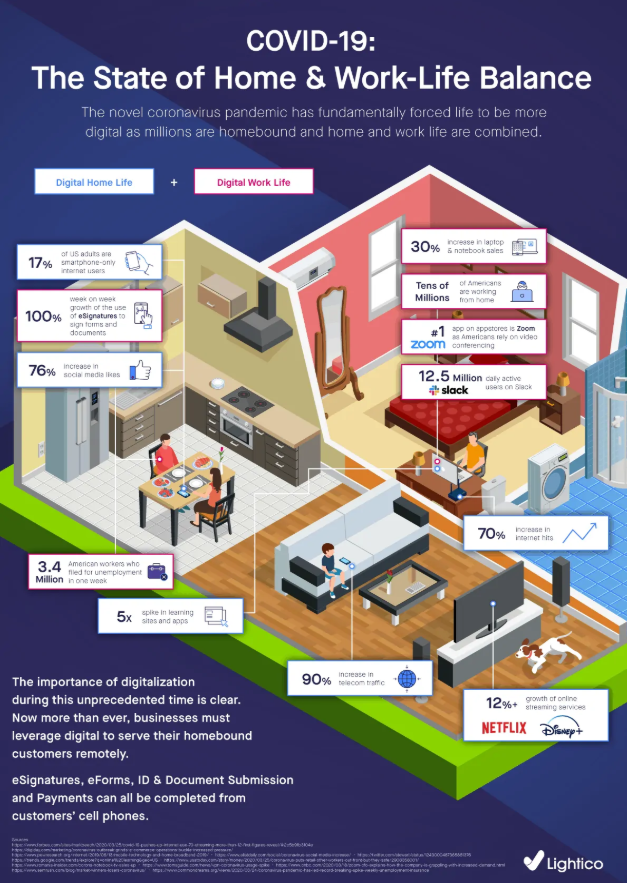
Home and Work-Life Balance
Ways To Battle Employee Stress
The key to learning how to manage stress at work so to keep it at a healthy level and make sure it doesn’t become overwhelming. There are warning signs that you’re experiencing too much stress at work such as:
Feeling anxious
Irritable or depressed.
Fatigue
Headaches
Social withdrawal
Apathy or loss of interest at work
Trouble sleeping
And problems concentrating
We’ve got a few simple ideas that could help reduce the employee stress at your business.
Form Positive Relationships
Share your thoughts and get things off your chest.
Develop Friendships with coworkers
Lean on your friends and family for support
Start Exercising or Exercise More
Exercise lifts your mood, increases energy, and sharpens focus.
Shoot for at least 30 minutes of activity on most days.
Go for walks throughout the day to de-stress.
Eat Healthy and Nutritious Foods
Reduce your sugar consumption to avoid energy crashes.
Eat more Omega-3 fatty acids for improved mood.
Avoid stimulants like caffeine or nicotine.
Get Enough Sleep
Aim for 8 hours of sleep each nights.
Turn off screens 1 hour before you want to go to bed.
Prioritize and Organize
Plan regular breaks throughout your day.
Prioritize your most important tasks and projects earlier in the day.
Delegate the things you don’t have to do yourself.
Kick Your Bad Habits
Resist trying to be perfect with everything.
Think positively and don’t beat yourself up over little things.
Don’t sweat over things out of control.
California’s Leader in Insurance and Risk Management
As one of the fastest growing agencies in California, GDI Insurance Agency, Inc. is able to provide its clients with the latest and greatest of what the insurance industry has to offer and much, much more.
We are headquartered in Turlock, CA, with locations across the heart of California’s Central Valley, Northern California and beyond to provide a local feel to the solutions and services we provide our clients. We pride ourselves on exceeding our client’s expectations in every interaction to make sure that our client’s know how much we value and appreciate their business. Contact us today 1-209-634-2929 for your comprehensive insurance quote!
Reopening a Business After the Coronavirus Shutdown
As the coronavirus (COVID-19) pandemic continues to have an unprecedented effect on daily life, many business owners are looking forward to the future and a return to normalcy. However, even when stay-at-home orders are lifted and nonessential businesses are allowed to resume operations, there’s a lot for organizations to consider before they get to reopening their business after the Coronavirus Shutdown. What’s more, many of these considerations are workplace-specific and could be more involved depending on the industry you operate in.
To protect their customers and employees alike, it’s important for organizations to do their due diligence before opening their business back up to the public following the COVID-19 pandemic.
Determining When Reopening a Business After the Coronavirus Shutdown
While many essential businesses (e.g., hospitals, pharmacies, grocery stores and gas stations) have remained open during the COVID-19 pandemic, other operations deemed nonessential have shut down temporarily or changed the nature of their operations. Not only has this led to significant business disruptions, but, for many, it has critically impacted their bottom line.
However, we may be nearing a time when stay-at-home regulations are scaled back and all businesses are allowed to resume as normal. The question then is: How will business owners know it is acceptable to reopen? The following are some best practices to keep in mind:
Review guidance from state and local governments—The COVID-19 pandemic impacts states and regions in different ways. Just because a business is allowed to reopen in one region of the country doesn’t automatically mean your operations will be allowed to resume as well. As such, it’s critical to understand and review all relevant state and local orders to determine if and when your business is allowed to reopen.
Understand the risks—If and when the government allows all businesses to reopen, that doesn’t necessarily mean COVID-19 is no longer a threat to your operations. What’s more, some businesses may have greater COVID-19 exposures than others, underscoring the importance of performing a thorough risk assessment before reopening. Prior to conducting a risk assessment, it’s important to review guidance from the Occupational Safety and Health Administration (OSHA), state and local agencies, industry associations as well as your local health department. More information on conducting a risk assessment can be found below.
Again, before reopening, it’s critical to seek the expertise of legal, insurance and other professionals.
Conducting a Risk Assessment
Even after the government allows businesses to reopen, firms still need to determine if it makes sense to resume operations. Safely restarting your business won’t be as simple as unlocking the front door.
Before reopening a business after the Coronavirus shutdown, businesses should perform a risk assessment to determine what steps must be taken. While the complexity of risk assessments will differ from business to business, they typically involve the following steps:
Identifying the hazards—When it comes to COVID-19, businesses need to think critically about their exposures, particularly if an infected person entered their facilities. When identifying hazards, it’s a good idea to perform a walkthrough of the premises and consider high-risk areas (e.g., breakrooms and other areas where people may congregate). It’s also important to consider what tasks employees are performing and whether or not they are especially exposed to COVID-19 risks when performing their duties.
Deciding who may be harmed and how—Once you’ve identified hazards to your business, you need to determine what populations of your workforce are exposed to COVID-19 risks. When performing this evaluation, you will need to make note of high-risk individuals (e.g., staff members who meet with customers or individuals with preexisting medical conditions).
Assessing risks—Once you have identified the risks facing your business, you must analyze them to determine their potential consequences. For each risk facing your business, you’ll want to determine:
How likely is this particular risk to occur?
What are the ramifications should this risk occur?
When analyzing your risks, consider potential financial losses, compliance requirements, employee safety, business disruptions, reputational harm and other consequences.
Controlling risks—With a sense of what the threats to your business are, you can then consider ways to address them. There are a variety of methods businesses can use to manage their risks, including:
Risk avoidance—Risk avoidance is when a business eliminates certain hazards, activities and exposures from their operations altogether.
Risk control—Risk control involves preventive action.
Risk transfer—Risk transfer is when a business transfers their exposures to a third party.
For COVID-19, control measures could include cleaning protocols, work from home orders and mandated personal protective equipment (PPE) usage. Additional workplace considerations can be found below.
Monitoring the results—Risk management is an evolving, continuous process. Once you’ve implemented a risk management solution, you’ll want to monitor its effectiveness and reassess. Remember, COVID-19 risks facing your business can change over time.
Maintaining Workplace Safety Using OSHA and CDC Guidance
Once you conduct a risk assessment, you will need to act to control COVID-19 risks. Again, risks and the corrective steps that organizations take to address those risks will vary by business and industry.
Thankfully, there are a number of OSHA and Center for Disease Control and Prevention (CDC) workplace controls to consider if your risk assessment determines that COVID-19 poses a threat to your employees or customers. For instance, you should:
Implement administrative controls—Typically, administrative controls are changes in work policies or procedures that reduce or minimize an individual’s exposure to a hazard. An example of an administrative control for COVID-19 is establishing alternating days or extra shifts that reduce the total number of employees in a facility at a given time.
Utilize Personal Protective Equipment (PPE)— PPE is equipment worn by individuals to reduce exposure to a hazard, in this case, CVOID-19. Businesses should focus on training workers on and proper PPE best practices. Employees should understand how to properly put on, take off and care for PPE. Training material should be easy to understand and must be available in the appropriate language and literacy level for all workers.
Consider engineering controls—Engineering controls protect workers by removing hazardous conditions or by placing a barrier between the worker and the hazard. For COVID-19, engineering controls can include:
Installing high-efficiency air filters
Increasing ventilation rates in the work environment
Installing physical barriers, such as clear plastic sneeze guards
Be adaptable—You should be prepared to change your business practices if needed to maintain critical operations. This could involve identifying alternative suppliers, prioritizing existing customers or suspending portions of your operations.
Create a dialogue with vendors and partners—Talk with business partners about your response plans. Share best practices with other businesses in your communities, and especially those in your supply chain.
Encourage social distancing—Social distancing is the practice of deliberately increasing the physical space between people to avoid spreading illness. In terms of COVID-19, social distancing best practices for construction businesses can include:
Avoiding gatherings of 10 or more people
Keeping at least 6 feet of distance from other people
Hosting meetings virtually when possible
Limiting the number of people on the jobs site to essential personnel only
Encouraging staff to work from home when possible
Discouraging people from shaking hands
Manage the different risk levels of their employees—It’s important to be aware that some employees may be at higher risk for serious illness, such as older adults and those with chronic medical conditions. Consider minimizing face-to-face contact between these employees or assign work tasks that allow them to maintain a distance of 6 feet from other workers, customers and visitors.
Separate sick employees—Employees who appear to have symptoms (i.e., fever, cough or shortness of breath) upon arrival at work or who become sick during the day should immediately be separated from other employees, customers and visitors, and sent home. If an employee is confirmed to have COVID-19, employers should inform fellow employees of their possible exposure to COVID-19. The employer should instruct fellow employees about how to proceed based on the CDC Public Health Recommendations for Community-Related Exposure.
Support respiratory etiquette and hand hygiene—Businesses should encourage good hygiene to prevent the spread of COVD-19. This can involve:
Providing tissues and no-touch disposal receptacles
Providing soap and water in the workplace
Placing hand sanitizers in multiple locations to encourage hand hygiene
Perform routine environmental cleaning and disinfection—Businesses should regularly sanitize their facility to prevent the spread of COVID-19. Some best practices include:
Cleaning and disinfecting all frequently touched surfaces in the workplace, such as workstations, keyboards, telephones, handrails and doorknobs.
Discouraging workers from using other workers’ phones, desks, offices, or other tools and equipment, when possible. If necessary, clean and disinfect them before and after use.
Providing disposable wipes so that commonly used surfaces can be wiped down by employees before each use.
Continued Safety While Reopening a Business After the Coronavirus Shutdown
While resuming operations following the COVID-19 pandemic may seem like a daunting task, businesses don’t have to go it alone. To help with this process, organizations can seek the help of their insurance professionals to determine what actions they need to take to ensure their business reopens smoothly. To learn more, contact GDI Insurance Agency, Inc. today.
California’s Leader in Insurance and Risk Management
As one of the fastest growing agencies in California, GDI Insurance Agency, Inc. is able to provide its clients with the latest and greatest of what the insurance industry has to offer and much, much more.
We are headquartered in Turlock, CA, with locations across the heart of California’s Central Valley, Northern California and beyond to provide a local feel to the solutions and services we provide our clients. We pride ourselves on exceeding our client’s expectations in every interaction to make sure that our client’s know how much we value and appreciate their business. Contact us today 1-209-634-2929 for your comprehensive insurance quote!
As the number of reported cases of COVID-19 continues to rise, employers are increasingly confronted with the possibility of an outbreak in the workplace. We are reviewing theEmployer’s Guide to COVID-19, which you can download here. The first section is COVID-19 and your workforce.
Employers are obligated to maintain a safe and healthy work environment for their employees, but are also subject to a number of legal requirements protecting workers, for instance, the Occupational Safety and Health Act (OSH Act). This section of the toolkit provides a summary of the actions employers should take when confronted with COVID-19 and your workforce.
The COVID-19 is a disease caused by a member of the coronavirus family that is a close cousin to the SARS and MERS viruses that have caused outbreaks in the past. Symptoms of COVID-19 include fever, runny nose, cough and trouble breathing. Most people develop only mild symptoms. But some, usually people with other medical complications, develop more severe symptoms, including pneumonia, which can be fatal. The incubation period for COVID-19 is from two to 14 days.
Initially detected in Wuhan, China in late 2019, the first case of COVID-19 in the United States was reported on January 21, 2020. Since then, the disease has spread throughout the continental United States.
The available information about how the virus that causes COVID-19 spreads is largely based on what is known about similar coronaviruses. COVID-19 is a new disease, and there is more to learn about its transmission, the severity of illness it causes, and to what extent it may spread in the United States.
COVID-19 and Your Workforce
According to the CDC, the virus is thought to spread mainly from person to person, between people who are in close contact with one another (within about six feet) or through respiratory droplets produced when an infected person coughs or sneezes. These droplets can land in the mouths or noses of people who are nearby, or possibly be inhaled into the lungs. It may also be possible for a person to contract COVID-19 by touching a surface or object that has been contaminated with the virus and then touching his or her own mouth, nose, or eyes, but this is not thought to be the main way the virus spreads.
People are thought to be most contagious when they are most symptomatic. Some spread might be possible before people show symptoms, and there have been reports of this occurring, but this is not thought to be the main way the virus spreads.
Disease Prevention in the Workplace
Whenever a communicable disease outbreak is possible, employers may need to take precautions to keep the disease from spreading through the workplace. It is recommended that employers establish a written policy and response plan that covers communicable diseases readily transmitted in the workplace.
Employers can require employees to stay home from work if they have signs or symptoms of a communicable disease that poses a credible threat of transmission in the workplace, or if they have traveled to high-risk geographic areas, such as those with widespread or sustained community transmission of the illness. When possible, employers can consider allowing employees to work remotely. Employers may require employees to provide medical documentation that they can return to work.
Employers can consider canceling business travel to affected geographic areas and may request that employees notify them if they are traveling to these areas for personal reasons. Employees who travel to China should be informed that they may be quarantined or otherwise required to stay away from work until they can provide medical documentation that they are free of symptoms.
There are several legal considerations that employers should keep in mind when implementing and administering a communicable illness policy. These considerations are addressed in the following sections.
Responding to an Employee’s Positive Coronavirus Test
As the number of COVID-19 cases grows daily, employers across the country are dealing with the difficult situation of responding to an employee’s positive COVID-19 test.
Employers are responsible for handling the situation swiftly to protect the health of other employees while preserving the affected employee’s confidentiality. In addition to notifying the company and its customers, employers must also disinfect the office and evaluate next steps.
Responding to an Employee
When an employee notifies you that he or she is sick with COVID-19, you should respond calmly and empathetically. In these uncertain times, it can be easy to overreact, but you need to ensure that the infected employee is treated with compassion. Reassure the employee that their identity will remain confidential, and be sure to help them coordinate taking leave or paid time off until they’ve recovered.
You will also need to ask the employee some potentially difficult questions, including whom the employee has been in contact with in the last two weeks. Obtaining this information is essential so that you can directly notify customers and other employees that they may have been directly exposed to COVID-19.
Notifying Employees and Customers
Without disclosing the identity of the infected employee, you need to notify their co-workers, customers and the rest of the company.
Directly notify any co-workers or customers whom the ill employee had been in contact with. Be sure to remain calm and let them know that someone they have been in contact with or has been in their physical work area has tested positive for COVID-19. Recommend that they should self-quarantine for the next 14 days and monitor themselves for the symptoms of COVID-19. If feasible, allow eligible employees to work from home during this time.
Be sure to notify the rest of the company by email or letter that an employee has tested positive for COVID-19. Remember to keep the employee’s identity protected and be transparent about your response. The communication should include what steps your company will be taking to protect the health of other employees. If you plan on having employees work from home for the next 14 days or closing the office, this information should be disclosed in the communication.
Disinfecting the Office
According to the Centers for Disease Control and Prevention (CDC), COVID-19 can remain on hard surfaces for up to 12 hours, creating a potential risk of transmission. Depending on the size of your organization, you may want to consider closing the office for a few days so that it can be thoroughly cleaned and disinfected. All surfaces that the infected employee may have touched should be disinfected, as well as other high-touch surfaces, which include countertops, cabinets, doorknobs, handles and chairs.
California’s Leader in Insurance and Risk Management
As one of the fastest growing agencies in California, GDI Insurance Agency, Inc. is able to provide its clients with the latest and greatest of what the insurance industry has to offer and much, much more.
We are headquartered in Turlock, CA, with locations across the heart of California’s Central Valley, Northern California and beyond to provide a local feel to the solutions and services we provide our clients. We pride ourselves on exceeding our client’s expectations in every interaction to make sure that our client’s know how much we value and appreciate their business. Contact us today 1-209-634-2929 for your comprehensive business insurance quote!
Implementation of Mitigation Strategies for Communities with Local COVID-19 Transmission
When a novel virus with pandemic potential emerges, non-pharmaceutical interventions, which will be called community mitigation strategies in this document, often are the most readily available interventions to help slow transmission of the virus in communities. Community mitigation is a set of actions that persons and communities can take to help slow the spread of respiratory virus infections. Community mitigation is especially important before a vaccine or drug becomes widely available.
The following is a framework for actions which local and state health departments can recommend in their community to both prepare for and mitigate community transmission of COVID-19 in the United States. Selection and implementation of these actions should be guided by the local characteristics of disease transmission, demographics, and public health and healthcare system capacity.
Mitigation Strategies and Goals
The goals for using mitigation strategies in communities with local COVID-19 transmission are to slow the transmission of disease and in particular to protect:
Individuals at increased risk for severe illness, including older adults and persons of any age with underlying health conditions (See Appendix A)
The healthcare and critical infrastructure workforces
These approaches are used to minimize morbidity and mortality and the social and economic impacts of COVID-19. Individuals, communities, businesses, and healthcare organizations are all part of a community mitigation strategy. These strategies should be implemented to prepare for and when there is evidence of community transmission. Signals of ongoing community transmission may include detection of confirmed cases of COVID-19 with no epidemiologic link to travelers or known cases, or more than three generations of transmission. Implementation is based on:
Emphasizing individual responsibility for implementing recommended personal-level actions
Empowering businesses, schools, and community organizations to implement recommended actions, particularly in ways that protect persons at increased risk of severe illness
Focusing on settings that provide critical infrastructure or services to individuals at increased risk of severe illness
Minimizing disruptions to daily life to the extent possible Guiding principles
Each community is unique, and appropriate mitigation strategies will vary based on the level of community transmission, characteristics of the community and their populations, and the local capacity to implement strategies (Table 1).
Consider all aspects of a community that might be impacted, including populations most vulnerable to severe illness and those that may be more impacted socially or economically, and select appropriate actions.
Mitigation strategies can be scaled up or down depending on the evolving local situation.
When developing mitigation plans, communities should identify ways to ensure the safety and social well-being of groups that may be especially impacted by mitigation strategies, including individuals at increased risk for severe illness.
Activation of community emergency plans is critical for the implementation of mitigation strategies. These plans may provide additional authorities and coordination needed for interventions to be implemented (Table 2).
Activities in Table 2 may be implemented at any time regardless of the level of community transmission based on guidance on from local and state health officials.
The level of activities implemented may vary across the settings described in Table 2 (e.g., they may be at a minimal/ moderate level for one setting and at a substantial level for another setting in order to meet community response needs).
Depending on the level of community spread, local and state public health departments may need to implement mitigation strategies for public health functions to identify cases and conduct contact tracing (Table 3). When applied, community mitigation efforts may help facilitate public health activities like contact tracing
California’s Leader in Insurance and Risk Management
As one of the fastest growing agencies in California, GDI Insurance Agency, Inc. is able to provide its clients with the latest and greatest of what the insurance industry has to offer and much, much more.
We are headquartered in Turlock, CA, with locations across the heart of California’s Central Valley, Northern California and beyond to provide a local feel to the solutions and services we provide our clients. We pride ourselves on exceeding our client’s expectations in every interaction to make sure that our client’s know how much we value and appreciate their business. Contact us today 1-209-634-2929 for your comprehensive insurance quote!
The World Health Organization (WHO) has designated the recent coronavirus outbreak (COVID-19) a global public health emergency. According to the Centers for Disease Control and Prevention (CDC), coronaviruses are common in animal species. Although most don’t affect humans, the most recent strain, COVID-19, does and can easily spread from person to person. What you need to know about coronavirus and an event.
Coronaviruses typically cause mild upper
respiratory tract illnesses, and those affected exhibit cold-like symptoms
(e.g., headache, cough, fever, sore throat and runny nose). Some coronaviruses,
like COVID-19, can be more severe, and individuals may experience
lower-respiratory tract illnesses like bronchitis and pneumonia. For the
elderly, infants and those with weakened immune systems, COVID-19 can be
deadly.
Because COVID-19 is highly contagious and
potentially life-threatening, it’s critical that organizations take the proper
precautions to protect individuals. This is especially true for businesses that
plan on hosting large events where just one misstep can lead to the quick
spread of COVID-19 among attendees. This Risk Insights highlights guidance from
the CDC regarding preparing your event for coronavirus.
Review Emergency Operation Plans
The first step
for preparing your event for COVID-19 involves reviewing your emergency
operations plan. To accomplish this, consider doing the following:
Meet with the emergency operations coordinator or planning team at your venue. Discuss the emergency operations plan and determine how it may impact aspects of your event, such as personnel, security, services, activities, functions and resources. Develop a contingency plan that addresses various scenarios.
Establish relationships with key community partners and stakeholders. When forming key relationships for your event, include relevant partners, such as the local public health department, community leaders, faith-based organizations, vendors, suppliers, hospitals, hotels, airlines, transportation companies and law enforcement officials. Collaborate and coordinate with them on broader planning efforts. When doing so, clearly identify each partner’s role, responsibilities and decision-making authority. You should also contact your local public health department for a copy of their outbreak response and mitigation plan for your community and participate in communitywide emergency preparedness activities.
Address Prevention Strategies in Your Emergency Operations Plan
The second step
for preparing your event for COVID-19 involves addressing prevention strategies
in your emergency operations plan. To accomplish this, consider doing the
following:
Promote
preventive actions. Use health messages and materials developed by credible
public health sources—such as your local public health department or the CDC—to
encourage your event staff and participants to practice good personal health
habits. Promote everyday
preventive actions to help prevent the spread of COVID-19, recommending
that individuals:
Stay home when they are sick, except to get
medical care.
Cover their mouth with a tissue when they cough
and sneeze.
Wash their hands often with soap and water for
at least 20 seconds, especially after going to the bathroom; before eating; and
after blowing their nose, coughing or sneezing.
Avoid touching their eyes, nose and mouth with
unwashed hands.
Clean frequently touched surfaces and objects
daily.
Provide
COVID-19 prevention supplies at your event. Plan to have extra
supplies on hand for event staff and participants, including hand-washing
stations equipped with soap, hand sanitizer, tissues and disposable face masks
for individuals who are experiencing COVID-19 symptoms.
Plan for
staff absences. Develop flexible attendance and sick-leave policies.
Event staff needs to stay home when they are sick or if they have to care for a
sick household. As such, it’s important to identify critical job functions and
positions, and plan for alternative coverage by cross-training staff.
Promote
messages that discourage people who are sick from attending events. This
should include messages requesting that people leave events if they begin to
have symptoms of COVID-19, which include fever, cough and shortness of breath.
They should seek medical advice promptly by calling ahead to a doctor’s office
or emergency room.
Identify
a space that can be used to isolate staff or participants who become ill at the
event. Designate a space for staff and participants who may become
sick and cannot leave the event immediately. Work with partners, such as local
hospitals, to create a plan for treating staff and participants who do not live
nearby. Include a plan for separating and caring for vulnerable populations.
Plan ways
to limit in-person contact for staff supporting your event. There are several
ways to do this, including offering staff the option to work remotely if they
can perform their job duties off-site. Reduce the number of staff needed by
staggering shifts for staff who support essential functions and services during
events.
Develop
flexible refund policies for participants. Create refund policies that allow
participants to stay home when they are sick, need to care for sick household
members or are at high risk for complications from COVID-19.
Identify
actions to take if you need to postpone or cancel events. Work closely
with local public health officials to assess local capacities in the area.
During a COVID-19 outbreak, resource limitations among local health care
systems or law enforcement can influence the decision to postpone or cancel
your event. If possible, plan alternative ways for participants to enjoy the
event (e.g., television, radio or digital broadcasts).
Communicate COVID-19 to Guests and Event Staff
The third step
for preparing your event for COVID-19 involves creating a communication plan to
keep guests informed. To accomplish this, consider doing the following:
Update
and distribute timely and accurate emergency communication information. Identify
everyone in your chain of communication (e.g., event staff, participants,
suppliers, vendors and key community partners) and establish systems for
sharing information with them. Maintain up-to-date contact information for
everyone in the chain of communication. You should also identify platforms,
such as phone hotlines, automated text messaging systems or websites, to help
disseminate information.
Identify
and address potential language, cultural and disability barriers associated
with communicating COVID-19 information to event staff and participants. Above
all, information you share should be easily understood by everyone attending
the event.
Stay Informed
Despite the current low level of risk for the average American employee, it is important to understand that the COVID-19 situation evolves and changes every day. Employers should closely monitor the CDC and WHO websites for the latest and most accurate information on COVID-19. Source: Centers for Disease Control and Prevention
California’s Leader in Insurance and Risk Management
As one of the fastest growing agencies in California, GDI Insurance Agency, Inc. is able to provide its clients with the latest and greatest of what the insurance industry has to offer and much, much more.
We are headquartered in Turlock, CA, with locations across the heart of California’s Central Valley, Northern California and beyond to provide a local feel to the solutions and services we provide our clients. We pride ourselves on exceeding our client’s expectations in every interaction to make sure that our client’s know how much we value and appreciate their business. Contact us today 1-209-634-2929 for your comprehensive insurance quote!
We use cookies to optimize our website and our service.
Functional cookies
Always active
The technical storage or access is strictly necessary for the legitimate purpose of enabling the use of a specific service explicitly requested by the subscriber or user, or for the sole purpose of carrying out the transmission of a communication over an electronic communications network.
Preferences
The technical storage or access is necessary for the legitimate purpose of storing preferences that are not requested by the subscriber or user.
Statistics
The technical storage or access that is used exclusively for statistical purposes.The technical storage or access that is used exclusively for anonymous statistical purposes. Without a subpoena, voluntary compliance on the part of your Internet Service Provider, or additional records from a third party, information stored or retrieved for this purpose alone cannot usually be used to identify you.
Marketing
The technical storage or access is required to create user profiles to send advertising, or to track the user on a website or across several websites for similar marketing purposes.